Blog

  • How Do I Become A Computer Programmer?

    If you like to delve deeper into projects and understand how things work underneath the design, then a computer programmer may be the ideal career choice for you. As a computer programmer, you’ll be responsible for turning plans and programs made by software engineers, into the code that a computer (or another device) can follow.
    Put simply; a computer programmer builds the instructions and code so that someone else’s designs can come to life.
    If you like to create your own designs as well as programming them, there are lots of roles available looking for these entrepreneurial types who can design, create and build.

    What can I do as a computer programmer?

    There are lots of roles available for a computer programmer. For example, computer programmers can become back-end web developers who create instructions that bring website design and functionality to life. You may want to work in developing new programming systems such as working with Artificial Intelligence.
    If you have a science background, then you may want to use your knowledge and computer programming skills to become a data scientist. Scientists often use computer programming code, such as Python, to study, analyse and manipulate data.
    If you prefer mathematics and statistics, then there are lots of jobs across a range of different industries that require a database administrator or programmer who can protect businesses by safely storing, organising and analysing data.
    Computer programmers can also secure roles in developing software, systems and apps across a range of businesses in a variety of industries. As a programmer, you may find yourself in industries you never expected, thanks to your transferable and universal skills.
    As well as writing code, computer programmers may also be responsible for testing code, analysing the system for errors and then rewriting and troubleshooting any issues. A programmer may be accountable for the ongoing maintenance of a program, ensuring it remains functional and effective while making the necessary updates when they are required.

    How to become a computer programmer

    There are lots of different routes to becoming a computer programmer. It is widely thought that a computer programmer will have a bachelor’s degree in a subject such as computer science, information systems, or mathematics.
    While a degree may help, it is not the only route to becoming a computer programmer. With experience in the field of computer programming that you want to work in and knowledge of one or more programming languages, many businesses will be willing to take on candidates without a degree.
    Another route to becoming a computer programmer is to look for junior programming roles where organisations are willing to give training to their programmers while working.

    Salaries for computer programmers

    Junior programmers can expect a salary upwards of £20,000. Of course, this may vary depending on the organisation and location of the business. However, once you become an expert programmer or have specific expertise or skillset in a niche area, then programmers can command salaries of more than £70,000.
    Furthermore, providing programming consultancy services for businesses can command even higher prices, with rates of more than £100 per hour.

    Skills required to become a programmer

    Introduction To Programming

    Make sure you are ready for your interview and are sure programming is right for you by first completing an introductory programming course. Before settling on the programming language you want to focus on, or the niche industry you wish to pursue, an Introduction to Programming course can help you to become familiar with the concepts of programming and the relevant terminology.
    At TSG Training, we run a three-day introductory course that is ideal for those who are new to programming and want to learn more about it. During the three days, candidates will acquire skills and learn more about the different techniques of programming with practical hands-on experience. Find out more about what you can learn on the course here.

    Problem-solving

    A large proportion of a computer programmer’s role will be to look at systems and seek out where problems or issues may crop up. Furthermore, it will be the responsibility of the programmer to not only look for where problems may appear but also solve these issues too.
    With this skill, it is essential to apply critical thinking. This is where you weigh up all your options and take a considered approach before selecting the best way forward. Employers will look favourably on candidates who can make the right decision and can back up their decision with evidence.

    Programming language

    If you already know what type of programmer you want to be, then there may be specific programming languages that you know you need to learn. However, if you simply want to get into the world of programming, then these languages are typically the most common languages for programmers to learn;
    JavaScript – This is a versatile and broadly used programming language that can be used in both front and back end development. Many game developers and AI developers also use JavaScript thanks to its interactivity.
    Python – Often used in science backgrounds and software development, Python is now a language of choice for many coders. Python not only supports data and academic or scientific research, but it also is a prominent coding language in technologies such as machine learning and intelligence.
    CSS/HTML – while CSS and HTML are two different aspects, they both work together. Moreover, it is essential to learn both together because of their interaction. These are mainly used for front-end development of websites, so can be a useful skill to have so that you have full stack (both front and back end) knowledge.
    At TSG Training, we want to support your training as a computer programmer. If you want to learn more about programming or about learning programming language skills, then get in touch with our team to find out more. Use our live chat function or call us for free on 08000 199337 to kickstart your programming career.

  • What Are The Skills Required For A PHP Developer?

    Did you know that over 78% of the entire web is built using PHP? With this in mind, becoming a PHP developer is a much-wanted skill for businesses that require websites, applications, and programs. Whether you want to work for a start-up or massive enterprise, or simply create websites yourself, PHP is a fantastic skill to have and becoming a PHP developer will undoubtedly open the door to lots of opportunities, wherever you want to work.
    So, what does it take to become a PHP developer, and what are the vital PHP developer skills to acquire?

    What Is PHP?

    Once known as Personal Home Page, PHP is now short for Hypertext Preprocessor and is a form of scripting language that developers can use for a range of purposes but usually web development. The PHP script language is popular because, unlike other script languages, you can execute the commands on the server, which then generates an HTML code. This means that clients or web users will be unable to detect what underlying code you are actually using.
    A significant benefit of PHP is that thanks to its server-side scripting, it is quite a simple scripting language to pick up, and it is perfect for those who are new to web development to learn. However, despite being simple to learn, it does have an extensive range of features that means it is ideal for advanced professional PHP programmers too.

    What Is A PHP Developer?

    Often described as web developers, software developers, or app developers, a PHP developer uses the PHP script to create interfaces for a business or client. PHP developers are wanted in enterprises to work behind the scenes of the company’s websites, software, and apps. However, PHP development is also a popular self-employed or freelance role as many companies or clients will employ PHP developers for specific projects.
    As PHP is a top language for start-ups and small businesses, many PHP developers will support a variety of organisations in their fledgling state. This can bring a great deal of satisfaction to watch these start-up businesses grow thanks to the interfaces that you create.
    Typically, a PHP developer’s role will include aspects such as creating interfaces such as websites or website functions (this also includes software and apps, too). However, other tasks will consist of site administration, creating dynamic content for sites and testing the software.
    In some cases, a PHP developer will create a prototype of the site they want to create in PHP thanks to the speed and ease of creation. However, once the prototype receives approval, they will then transfer it to another scripting language.
    If you have a marketing or advertising background, then becoming a PHP developer may be the next logical step as PHP is a popular language for advertising and design projects.

    Why Become A PHP Developer?

    As an in-demand skill, you can expect attractive salaries for a PHP developer in the UK. A UK average salary for a PHP developer is £47,500. However, in technology hotspots such as Manchester, Bristol, and London, an experienced PHP developer can command a higher salary. The average salary for a PHP developer in London is £62,500 with a higher limit at around £72,500. In Bristol, the average wage is £52,500, with an upper limit of approximately £67,500.

    PHP Developer Skills

    If you want to become a PHP developer, then there are some critical skills to build up in order to land your first PHP developer role. These PHP developer skills include;

    PHP Programming

    While PHP is a relatively simple scripting language to pick up, the abilities of PHP are so extensive that it is wise to take part in a professional training course that covers PHP programming. During which, you can learn how to develop and maintain scripts as well as increase the functionality of PHP by learning how to create and use external PHP code, use PHP in an HTML space and create scripts using logical, relational and arithmetic systems and operators.
    Find out more about PHP Programming training here.

    Communication

    As a PHP developer, you will be responsible for creating, building and maintaining interfaces at the request of the business or client. As a result, you will need to make sure you are entirely sure of the demands and objectives of the task.
    It is important to remember that most requests will come from people who do not have the same technical skills and web development understanding as you. This will mean you will have to communicate in ways that are easy to understand if they don’t have knowledge of PHP.
    It may not seem like a skill, but clients and businesses will favour PHP developers that are willing to communicate in a professional way that makes understanding between front end and back end clear. As a result, an e-learning course on business communication can be a great help.

    MySQL

    Generally speaking, MySQL goes hand in hand with PHP development. As a result, it is best to learn both of these technical skills at the same time. MySQL is the database system that will allow you to develop PHP and HTML code. It is essential to learn how PHP and MySQL work together. This includes understanding the configuration of the code and the syntax of the system.
    At TSG Training, we offer a fantastic opportunity to get to grips with both PHP and MySQL in a comprehensive and convenient two-day course. If you are looking to utilise PHP and MySQL within your work or for your clients, this is an ideal course that covers the critical elements such as how PHP interacts and MySQL and the security implications that go with it.

    Project Management

    In most cases, PHP developers will be responsible for specific projects. Each of these projects will have different budgets, milestones, scopes, proposals, and end dates. More often than not, a PHP developer will have to manage multiple projects at the same time. This is why having an ability to plan and manage projects is essential for PHP developers. Make sure you can deliver and exceed client or business expectations by mapping out your project before you begin.
    In some businesses, you may have to follow a specific form of project management. For example, this could be PRINCE2® or Agile. As a result, having a basic grasp of a variety of project management techniques will help all of your projects to run smoothly.

    What To Improve Your PHP Developer Skills?

    If you’re looking to improve your web development skills with PHP knowledge, then speak to the team at TSG Training. Our friendly team can help you find the ideal web development or PHP training course for your needs. Simply call 08000 199337 or use our live chat function on our website to find out more.

  • Software Testing Techniques

    To ensure an effective product, software testing is essential. From functional to non-functional testing, ensuring you have tried and checked every aspect of the software can provide a range of benefits. For example, it can help to improve the cost-effectiveness of your project by spotting issues in the early phases. Software testing techniques also help to review and strengthen security which is essential for the current GDPR rules in place.
    Software testing also helps to verify the quality of the product, giving you peace of mind before releasing it into the market.
    When it comes to checking the software, it is essential to conduct a range of tests for comprehensive results. This means it is vital to have an understanding of a variety of different software testing techniques and an ability to deploy these different techniques effectively.

    Types Of Software Testing

    There are two main types of software testing: white box and black box techniques.
    Black box testing focuses on testing software from the point of view of the user and doesn’t require the tester to know the programming languages of the software or how it has been implemented.
    White box testing is where the tester analyses the internal structure of the software. It is called white box, clear box, glass box or open box testing as the tester can clearly see the ‘inside’ of the system. Some may also refer to white box testing as code-based testing or structural testing.
    At TSG Training, we offer a one-day highly interactive course for Software Testing Techniques. This course involves discussing a variety of testing techniques including white box and black box techniques. Learners can then discover more about these techniques through practical workshops and project simulations. Some of the software testing techniques that you can learn more about during the course include;

    Five Popular Software Testing Techniques

    Decision Table Based Testing

    Also known as a cause-effect table, a decision table is a testing technique that can check functions that require a combination of inputs or events. For example, this could be a questionnaire or data form where a user has to enter text into all of the required fields.
    To create a decision table, you can add the various inputs into rows and then enter all of the rules into columns.You can then fill the table with all of the combinations of inputs. In the final row, you can note the output against the input combination.

    Boundary Value Analysis

    As errors typically occur at the boundaries of input values, boundary value analysis is a type of testing that exercises the bounding values. The test summarises that if the system works well for the particular values testing, then it will work well for all values between the two boundaries.
    For Boundary Value Analysis, it is essential to test the input conditions outside of the boundaries. For example, in testing input conditions between one and ten, then Boundary Value Analysis should test values above and below these conditions, e.g. zero and eleven.

    State Transition

    Another form of software testing is State Transition which is used to evaluate system behaviour and will typically assess what happens when a user begins a sequence of events. An example of this is entering a password. If a user enters a password incorrectly, they will receive a prompt. If they enter their password incorrectly three times in a row, then access to the account will be blocked for a period of time.
    This type of testing is often diagrammed as a flow chart to demonstrate the different scenarios for each step of the sequence and the sequence as a whole.

    Equivalence Class Partitioning

    Equivalence Class Partitioning is a software testing technique that allows you to separate test conditions, and the output should be considered the same. This technique will enable you to work out which are valid and invalid equivalence classes and ensure they reach the right result.
    For example, A-E is valid, but F-J is invalid, and K-O is valid, but P-T is invalid.
    So, for this testing, you could expect an input of C to be a valid result but H to deliver an invalid result.

    Error Guessing

    This technique uses the software analyst’s experience to guess where issues may lie in the testing application. It is essentially is predicting where problems might be in the code. This may be because the code is particularly complex in certain areas.
    So, for this, a software analyst will write a test case that will expose potential errors or error-prone situations. As this is an experienced-based test, as software tester can use their knowledge of previous tests and past experience to identify conditions that may also affect this new software code.

    Want to find out more about software testing techniques?

    If you want to learn more about how to conduct software tests in accordance with ISO/IEC/IEEE29119 Software Testing Standards, then join TSG Training for a one-day course that is ideal for system testers, software developers, test managers, engineers and consultants.
    We offer this course as a public or private course if you have several delegates in your team that require training. Furthermore, there is no exam requirement for this particular training.
    Find out more here. Alternatively, you can call the team on 08000 199337, who will be happy to find the best training course to suit your needs.

  • Developing Professional Senior Test Engineers Into Lead Test Engineers

    1. Executive Summary

    This document sets out a vision for developing professional Senior Test Engineers into Lead Test Engineers/Test Team Managers/Technical specialists through a targeted learning and development programme. People passing through the programme will increase their own skills and competencies in multiple disciplines and, importantly, organisational capability to help deliver systems solutions that underpin day to day business operations.
    The programme has been developed in concert with (and rolled out to) a major systems integration company that was prepared to invest significantly in training to increase capability and extend its value proposition to new and existing clients alike.
    The days of people having a single skill have long gone, so this cogent learning and development programme is based upon achieving multi-skilled competencies for people and organisations in order to maximise staff utilisation and reduce operational costs and staff attrition rates.
    The programme comprises five learning and development streams, each of which seeks to imbue people with multi-layered competencies that are relevant to their experience and which provide extended capability within organisational teams – regardless of the development method they employ. The first stream defines a programme for apprentices and people new to testing, with the remaining four streams providing learning matched to career growth and the needs of a modern Test Practice. Each course within a stream has been mapped to SFIA, industry-accepted core principles, competencies and role types, as follows:

    1. Lead Test Engineerswith at least 4 years’ experience who are looking to become test managers with an additional specialism.;

    This stream will imbue staff with thy skills they need to manage and ensure the right approach to:

    • Test Manage and set strategy for programmes and projects
    • Act as a technical specialist in a chosen competency, such as performance or automation
    • Act in the capacity of product owner for small to medium-sized projects and programmes
    • Assess and mature test process, measurably and demonstrably
    • Advise and manage non penetrative aspects of security.

    We recommend that the programme of learning be scheduled to run for around 2 years in order to allow students time to use their learning through classroom and on the job training to give them solid learning opportunities as the progress toward graduation. Within the stream is:

    • Further details are available on request.
    • The following pages contain the training and support details for developing ‘Professional Senior Test Engineers’ into ‘Lead Test Engineers’ who are competent managers and technical specialists
    • A targeted learning & development programme that provides the necessary foundation for each person to take as part of building their general test capability and career growth;
    • A series of optional developmental paths and routes to allow a Test Practice to fulfil its specialist technical needs by developing staff with cross-functional competencies.

    For reference only, beyond the stream of learning defined here, there are a further two 2-year development streams to help Lead Test Engineers progress through to Test Architect/Consultant and Test Expert..

    2.Principles and Competencies of the Programme

    Following our experience of learning and development programmes and research into what companies require of testing in the future, we have defined a series of ‘Principles and Competencies’ that fit the gamut and need of corporate skills required to deliver first-class systems that help underpin business operations, ranging from raw intake through to experienced Lead Engineers, Architects, and Experts as follows:

    3.The 5-Stream Programme

    The professional Test Engineer career development programme contains five key streams, with each being rigorously designed and tested to reflect the principles and competencies that are key to success and growing capability within a Test Practice. Each stream interfaces seamlessly to the next to provide continuous investment in people and career growth:

    3.1 The Five Key Streams
    At the broadest level, each stream is designed to reflect modern test engineering principles, coupled with competencies that meet the needs of a Test Practice using varying development models, supported by capability from competent, multi-skilled individuals.

    1. The Test Engineerfor apprentices and entry level staff embarking on a career in software testing, and for experienced staff from other disciplines who may be transferring in.
    2. The Senior Test Engineerwith at least two years’ experience, who is ready to step up to using more advanced techniques, choosing to specialise or move to the early stages of team leadership.
    3. The Lead Test Engineerwith at least four years’ experience, already specialising and needing to be ready for the demands of test management or increasingly complex technical roles.
    4. The Test Architectwith at least five years’ experience, ready to make the jump to the business-critical role of defining and building test architectures for major programmes.
    5. The Test Expertwho has at least 10-years’ experience of leading major programme delivery and organisational change and benefit.

    3.2 The Lead Test Engineer

    The Lead Test Engineer stream is designed for people with at least four-years’ software testing on projects and who have expressed a desire to make it their next career goal of test manager or technical specialist and move up the ladder of seniority within a Test Practice.
    Students graduating Stream 3, ‘The Lead Test Engineer Stream’, are expected to join this stream at the beginning, whereas others with relevant experience can join at any point.

    3.2.1 The Lead Test Engineer Roadmap


    Some courses in Stream 3 are repeated from Stream 2. However, this is only to ensure that everyone has the full skill set. If a course has been taken in Stream 1 then it need not be taken again here.
    The stream supports the key competencies of:

    • Technical Testing
    • Automated Testing
    • Performance Testing
    • Team Leaders and aspiring Test Managers
    • Test Process Improvement
    • Security Testing.

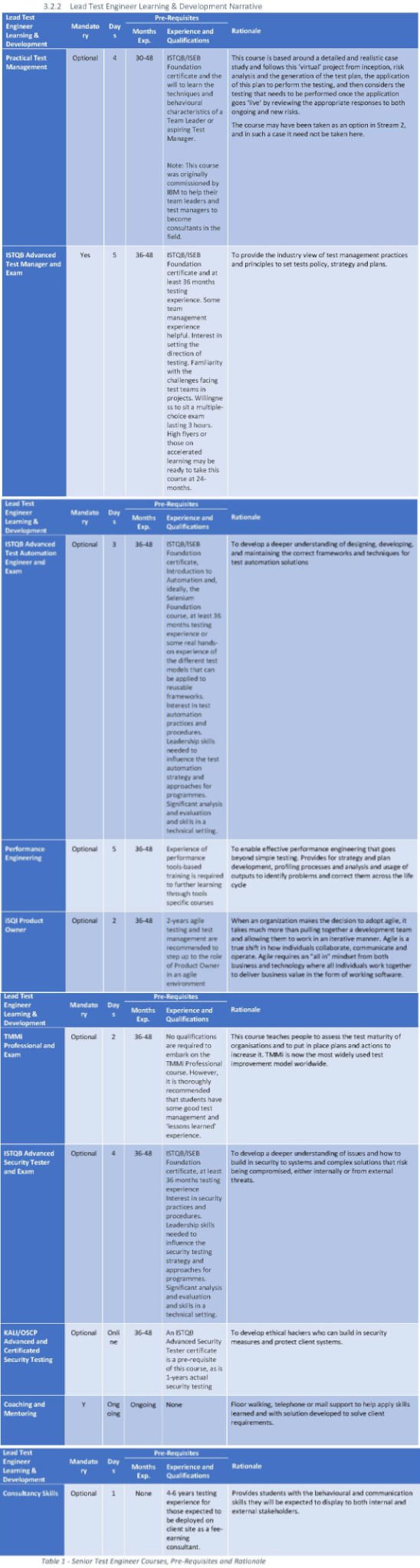
    Supporting 6 key competencies, Stream 3 contains two mandatory course and 6-optional course paths that allow the Lead Test Engineer to specialise in key skills areas as they progress toward Test Architect/Consultant and Test Expert. Whilst the paths are optional, we recommend that at least one be completed to graduate.
    It is the stream where consultancies and systems integration companies can be confident that the key staff have sufficient learning and capability to act as client facing consultant who can lead projects.
    It is not envisaged that any of the courses in this stream will be eligible for ‘Government Apprenticeship Funding’ unless someone is transferring into a role where there is a requirement to learn at least 51% of new skills to fulfil it.

    3.2.2 Lead Test Engineer Learning & Development Narrative

    4 Meeting the Needs of the Lead Test Engineer

    The programme has been designed to meet the skills of multiple business sectors and companies . It is composed of industry-accepted and proven courses to deliver best-practice training for Senior Test Engineers. The programme provides professional training that will allow Test Engineers to learn and develop on the job as they exercise acquired skills and increase competency in:

    • Automated Testing
    • Performance Testing
    • Security Testing
    • Technical Testing.
    • Test Process Improvement
    • Test Team Leadership/Management

    Training shall be delivered in the classroom with:

    • An experienced trainer who has real coal face experience;
    • A complete course manual and examples on which students can make their own notes;
    • Support from the trainer via email for life.

    5 Meeting the Needs of the Employer

    The programme is based upon industry best practice and support a series of different development methods that are used in the market today.
    TSG can work with the employer to define the most suitable work for students to undertake based upon each course.Work is expected to be exercised aligned with the skills learned in Section 4, Meeting the Needs of the Lead Test Engineer, above.
    The programme has been defined to turn out best-practice Lead Test Engineers, but it can be modified in technical content to meet the specific needs of any particular methods, environments, skills and architectures as the employer may rely upon to underpin their business systems.

    6 Benefits of the Approach

    In helping to meet the requirements of building capability within a modern Test Practice we have clearly delineated the roles and mapped them to training functions to be supported, aligned with stated principles and competencies:

    • Courses will be delivered by experienced staff who have at least 20-years’ experience gained from training and programme delivery at the sharp-end.
    • The experience the trainers bring will allow them to offer the ever-important analogies and war-stories to make training relevant and accessible.
    • Courses can be tailored to meet specific requirements; although for ISTQB courses we are limited to 10% variation without having to reaccredit.
    • We can provide private training courses anywhere or staff can attend any of the courses that we run on our public schedule.
    • We will agree and put in place a monitoring and measurement system to make sure that:
      • The delegate experience is rich.
      • People are passing exams at the expected rate.
      • The overall programme is delivering against its aims.

    A. Training & SFIA Cross Reference

    The following table identifies:

    • The Knowledge Levels (K) that each course and exam is aimed at:
    • The SFIA Levels and the suitability of courses by the identified role types.