Blog

  • The role of change management training in organisational success

    The role of change management training in organisational success

    Whether it’s adopting new technologies, restructuring departments, or shifts in market dynamics, organisations must continuously evolve to stay competitive. However, managing change effectively is often a significant challenge. This is where change management training becomes crucial.

    By equipping leaders and employees with the skills and knowledge to manage change, organisations can navigate transitions more smoothly, minimise disruption, and ensure successful outcomes. So, what role does change management training play in organisational success?

    How change management can boost success

    Enhance adaptability

    Change management training helps build a culture of adaptability within an organisation. Employees and leaders who have undergone such training are better equipped to understand the necessity of change and are more likely to embrace it rather than resist it.

    This adaptability is essential in today’s rapidly changing business landscape, where organisations must pivot quickly in response to new opportunities or threats.

    Reduce resistance to change

    One of the primary reasons change initiatives fail is employee resistance. Change management training addresses this issue by helping individuals understand the psychological and emotional responses to change.

    By learning about the stages of change and the reasons behind resistance, employees can develop strategies to manage their reactions and become more supportive of change initiatives. This reduction in resistance is crucial for the smooth implementation of new processes, technologies, or strategies.

    Empower leaders

    Effective change management starts at the top. Leaders play a pivotal role in guiding their teams through transitions. Change management training equips leaders with the tools to plan, communicate, and execute change initiatives effectively. This training helps leaders anticipate challenges, address concerns, and maintain morale during periods of change.

    Empowered leaders can inspire confidence and foster a sense of stability, even when the organisation is undergoing significant transformations.

    Enhance communication

    Clear and consistent communication is vital during any change process. Change management training emphasises the importance of transparent communication and provides techniques for effectively conveying the reasons for change, the benefits it will bring, and the steps involved in the transition.

    Effective communication reduces uncertainty and helps align everyone in the organisation towards a common goal, ensuring the change is understood and accepted at all levels.

    Provide structure

    Change management training introduces a structured approach to implementing change. This includes setting clear objectives, creating a detailed change management plan, and establishing metrics to measure success.

    A structured approach ensures that all aspects of the change are considered, from stakeholder engagement to risk management, which increases the likelihood of a successful outcome.

    Manage the human side

    One of the most challenging aspects of any change initiative is managing the human side – how people react and adapt to the new ways of working.

    Change management training focuses on understanding human behaviour and developing strategies to support employees throughout the transition. This includes providing the necessary training, resources, and support to help employees adapt to change, reducing anxiety and improving overall morale.

    Reduce downtime

    Change often comes with a temporary dip in productivity as employees adjust to new processes or systems. Change management training helps organisations plan for this by identifying potential disruptions and developing strategies to mitigate them.

    By proactively addressing these challenges, organisations can minimise downtime and maintain productivity throughout the change process.

    Ensure continuity

    Business continuity is a critical concern during periods of change. Change management training teaches organisations how to ensure that essential functions remain operational while changes are being implemented. This includes identifying key processes that must continue uninterrupted and planning for contingencies in case of unexpected challenges.

    Ensuring continuity during change is essential to maintaining customer satisfaction and protecting the organisation’s reputation.

    Embed change in the culture

    Change management training not only equips employees with the skills to handle specific change initiatives but also helps embed change management practices into the organisational culture.

    When change management becomes a core competency, the organisation is better prepared to handle future changes, fostering a culture of continuous improvement. This cultural shift ensures that the organisation remains agile and capable of responding to new challenges and opportunities.

    Encourage innovation

    A well-trained organisation in change management is more likely to embrace innovation. When employees understand that change is managed effectively, they are more willing to propose and support new ideas. This openness to innovation is crucial for organisations looking to stay ahead of the competition and drive growth.

    Change management training creates an environment where innovation can thrive, leading to sustained organisational success.

    Sustain change

    Change management training is not just about implementing change but also about sustaining it. The success of a change initiative depends on whether the changes are embedded in the organisation’s operations and culture.

    Change management training provides the skills needed to monitor the long-term impact of change and make adjustments as necessary to ensure that the benefits of the change are realised over time.

    Enhance agility

    Organisations that invest in change management training are more agile and better equipped to respond to future changes. This agility is a significant competitive advantage in a business environment where the pace of change continues to accelerate.

    By continually improving their change management capabilities, organisations can remain resilient and successful, no matter what challenges lie ahead.

    Get ready for change with TSG Training

    Change management training is vital in ensuring that organisations can navigate change smoothly, reduce resistance, and maintain productivity. By empowering leaders, enhancing communication, and fostering a culture of continuous improvement, change management training helps organisations achieve their strategic goals and thrive in an ever-evolving landscape.

    Investing in change management training is not just about managing a single change initiative; it’s about building a resilient, adaptable, and successful organisation capable of sustaining long-term success. Explore our change management courses here, or talk to our team, who can advise on the best change management courses to suit your requirements.


  • Agile vs Scrum: Which project management methodology suits your team?

    Agile vs Scrum: Which project management methodology suits your team?

    In fast-moving projects, adapting quickly and efficiently to change is crucial. Project management methodologies like Agile and Scrum have become popular approaches to help teams manage projects more effectively. However, while these terms are often used interchangeably, they represent different concepts that serve distinct purposes.

    Understanding the differences between Agile and Scrum is essential in determining which methodology best suits your team. So, what’s suitable for your team?

    What is Agile?

    Agile is a broad project management philosophy emphasising flexibility, collaboration, and customer-centric development. Originating from the Agile Manifesto, which was introduced in 2001, Agile prioritises individuals and interactions over processes and tools, working software over comprehensive documentation, customer collaboration over contract negotiation, and responding to change over following a plan.

    The key components of Agile include:

    • Flexibility: Agile encourages teams to adapt to changes quickly, allowing for iterative development and continuous improvement
    • Customer involvement: Agile promotes frequent feedback from customers, ensuring that the final product aligns with their needs and expectations
    • Iterative development: Work is divided into smaller, manageable parts, called iterations or sprints, allowing teams to focus on delivering functional features in short cycles
    • Collaboration: Agile fosters close collaboration among team members, stakeholders, and customers, breaking down silos and encouraging communication

    When to use Agile:

    Agile is suitable for projects where requirements are expected to change or are not well-defined at the outset. It is ideal for teams that thrive in environments where flexibility, quick feedback loops, and customer involvement are key.

    Agile works well for software development, product innovation, and other projects requiring rapid adaptation to new information or market conditions.

    What is Scrum?

    Scrum is a specific framework within the Agile methodology, designed to manage complex projects. Scrum provides a structured approach to project management with defined roles, events, and artefacts. While Agile is a philosophy or mindset, Scrum offers a concrete process for implementing Agile principles.

    The key characteristics of Scrum include:

    • Defined roles: Scrum has three key roles – Product Owner, Scrum Master, and Development Team. Each role has specific responsibilities, ensuring clarity and accountability
    • Sprints: Scrum divides projects into fixed-length iterations called sprints, typically lasting two to four weeks. Each sprint aims to deliver a potentially shippable product increment
    • Scrum events: Scrum includes ceremonies such as Sprint Planning, Daily Stand-ups, Sprint Reviews, and Retrospectives, which structure the workflow and promote continuous improvement
    • Transparency: Scrum encourages transparency through artefacts like the Product Backlog, Sprint Backlog, and Burndown Charts, providing visibility into the project’s progress and challenges

    When to use Scrum:

    Scrum is particularly effective for teams that need a structured approach to project management but still want to maintain Agile’s flexibility. It is suitable for projects with clear goals but evolving requirements, where the focus is on delivering incremental value through regular, time-boxed sprints.

    Scrum is widely used in software development but can be adapted to various industries, including marketing, research, and product development.

    Comparing Agile and Scrum

    1. Scope and flexibility
    • Agile: As a broad philosophy, Agile offers more flexibility in its implementation. Teams can choose various Agile frameworks, such as Scrum, Kanban, or Lean, depending on their specific needs
    • Scrum: Scrum provides a more rigid structure with predefined roles, events, and processes. While it is flexible in allowing teams to adapt to changes during a project, the Scrum framework itself has a set of rules that need to be followed
    1. Project complexity and size
    • Agile: Agile is versatile and can be scaled to fit projects of various sizes and complexities. It is well-suited for projects with uncertain or rapidly changing requirements
    • Scrum: Scrum is typically better suited for smaller to medium-sized projects with a relatively stable team structure. For very large projects, Scrum can be scaled using frameworks like SAFe (Scaled Agile Framework) or LeSS (Large Scale Scrum)
    1. Team structure and roles
    • Agile: Agile teams are generally cross-functional, and the roles may be more fluid, with less emphasis on strict hierarchies
    • Scrum: Scrum defines specific roles, with clear distinctions between the responsibilities of the Product Owner, Scrum Master, and Development Team. This structure can be beneficial for teams that thrive on clear roles and accountability
    1. Decision-making and leadership
    • Agile: Agile promotes collective decision-making, with the team working together to determine the best course of action. Leadership is often more democratic, with a focus on collaboration and consensus
    • Scrum: Scrum involves more defined leadership roles, particularly with the Scrum Master, who ensures that the Scrum process is followed and that obstacles are removed. The Product Owner has the final say on what gets prioritised in the backlog
    1. Documentation and process
    • Agile: Agile methodologies tend to favour minimal documentation, focusing instead on delivering working software or products. However, the level of documentation can vary depending on the specific Agile framework being used
    • Scrum: While still lightweight in terms of documentation, Scrum requires certain artefacts (like the Product Backlog and Sprint Backlog) to be maintained. These artefacts are essential for ensuring transparency and tracking progress

    Making the Decision: Agile or Scrum?

    Choosing Agile

    • Your project has unclear or rapidly changing requirements
    • Your team values flexibility and iterative development
    • Customer involvement is crucial throughout the project lifecycle
    • You prefer a broader approach that can be tailored to various frameworks

    Choosing Scrum

    • You need a structured approach with defined roles and responsibilities
    • Your project benefits from regular, time-boxed delivery cycles
    • Your team prefers clear guidelines and processes
    • You want to implement Agile principles but require a specific framework to manage complexity

    Both Agile and Scrum offer significant advantages for managing projects in today’s fast-paced business environment. Agile provides a flexible, customer-focused approach that can be tailored to a wide range of projects and industries. Scrum, as a specific Agile framework, offers a more structured method that can help teams deliver consistent, incremental value.

    Ultimately, the choice between Agile and Scrum depends on your team’s specific needs, the nature of your projects, and your organisational culture. By understanding the strengths and limitations of each methodology, you can select the one that best aligns with your goals, ensuring successful project outcomes and a more effective, cohesive team.

    Ensure you’re ready for your chosen approach. Get training in Agile and Scrum with TSG Training.

  • Certified Tester Level Foundation – Wondering Where to Go Next?

    Certified Tester Level Foundation – Wondering Where to Go Next?

    Congratulations on achieving your Certified Tester Foundation Level (CTFL) certification! Earning this internationally recognised credential is a significant accomplishment, setting the foundation for a rewarding career in software testing. But now that you’ve checked this milestone off your list, you might ask yourself, what’s next?

    The software testing world is vast, with plenty of career paths, specialisations, and advanced certifications to explore. In this article, we’ll look at the options available to you after achieving your CTFL and provide guidance on how to elevate your skills and advance in the ever-growing field of software testing.

    Why stop at the foundation level?

    The Certified Tester Foundation Level provides a solid understanding of the basic principles of software testing. However, as the industry evolves, continuous learning is essential to stay relevant and competitive.

    Advancing your skills beyond the foundation level can open the door to more specialised roles, higher salaries, and leadership positions. It also allows you to take on more complex projects and contribute to improving the overall quality of software products.

    Here are a few compelling reasons to continue your professional development in software testing:

    Increased job opportunities: Advanced certifications and skills are highly valued by employers, offering you access to a wider range of career opportunities, including senior roles in testing, quality assurance (QA), or even management positions

    Higher earning potential: With additional certifications and expertise, you can command higher salaries and more lucrative contracts

    Specialisation opportunities: As technology advances, so do the specialisations within software testing. Areas like test automation, performance testing, and security testing are increasingly in demand

    Better problem-solving skills: As you move up in your career, you’ll face more complex testing challenges. Advanced training helps you develop the tools and knowledge to solve these issues efficiently

    What are the next steps after CTFL?

    Now that you’ve completed your foundation-level certification, here are the next steps you can take to continue your journey in software testing:

    Test manager

    If you’re interested in overseeing testing teams, coordinating testing activities, and managing the overall testing process, this module prepares you for leadership roles. You’ll gain skills in test planning, monitoring, and control, as well as risk-based testing.

    Develop your test management skills with ISTQB Advanced Test Manager Course.

    Test analyst

    This module focuses on improving your analytical skills for designing and implementing test cases. You’ll learn how to define test conditions, identify test techniques, and gain a deeper understanding of how to test effectively in a variety of software environments.

    Develop these skills with ISTQB Advanced Test Analyst.

    Technical test analyst

    This specialisation is geared towards testers who want to dive into the technical aspects of testing, such as automation, performance testing, and code-based testing. It’s ideal for those with a keen interest in the technical side of software development.

    The CTAL provides the skills and qualifications you need to advance to mid-level and senior testing roles, helping you become a recognised expert in your chosen area.

    Explore a range of follow-up testing certifications and courses.

    Developing automation testing skills

    Test automation is quickly becoming a must-have skill in the world of software testing. Many organisations are shifting towards automated testing to improve efficiency, reduce manual workloads, and shorten release cycles. If you haven’t already started working with automation tools, now is the perfect time to do so.

    Learning programming languages like Python, Java, or JavaScript can also enhance your automation testing abilities. By mastering test automation, you’ll become a key player in Agile and DevOps teams, where continuous integration and continuous testing are critical.

    Consider a leadership role in QA

    If you’re interested in transitioning into a leadership role, consider developing your quality assurance (QA) management skills. Test managers and QA leaders are responsible for setting testing strategies, leading teams, and ensuring the overall quality of software products.

    Your testing career is just beginning

    Achieving your Certified Tester Foundation Level certification is just the start of an exciting and dynamic career in software testing. Whether you pursue advanced certifications, specialise in niche areas like automation or security, or transition into leadership, the possibilities are endless.

    By continuing to invest in your skills and knowledge, you can become a sought-after expert in the software testing industry, helping businesses deliver high-quality products in an increasingly digital world.

    So, what’s next for you? The journey is in your hands, and with the right training and experience, you can unlock new opportunities, enhance your career, and make a meaningful impact in the ever-evolving field of software testing.

  • Is ITIL still relevant in 2024?

    Is ITIL still relevant in 2024?

    The Information Technology Infrastructure Library (ITIL) has long been a cornerstone of IT service management (ITSM), guiding organisations worldwide in delivering high-quality IT services. Developed in the 1980s, IT is now unrecognisable from what it was like then. So, as we advance through 2024, the question arises: Is ITIL still relevant?

    The evolution of ITIL

    ITIL was developed in the 1980s by the UK government’s Central Computer and Telecommunications Agency (CCTA) to create a set of standardised practices for IT service management.

    Over the decades, ITIL has undergone several revisions to stay aligned with the changing technological landscape. ITIL V3, introduced in 2007, brought a lifecycle approach to service management, emphasising continuous improvement.

    Transition to ITIL 4

    In 2019, ITIL 4 was launched to address the complexities of the modern IT environment. ITIL 4 introduced concepts such as the Service Value System (SVS) and the Four Dimensions Model, focusing on a more flexible and collaborative approach to IT service management. It emphasises Agile, DevOps, and Lean practices, reflecting the industry’s shift towards more adaptive and integrated frameworks.

    ITIL alignment with digital transformation

    In an era where digital transformation is a top priority for organisations, ITIL 4’s flexibility and holistic approach make it highly relevant. ITIL 4 supports the integration of emerging technologies such as artificial intelligence (AI), machine learning (ML), and cloud computing, ensuring that IT service management practices remain effective and forward-thinking.

    Enhancing customer experience

    Today’s businesses prioritise customer experience (CX), and ITIL’s focus on value creation aligns well with this trend. ITIL 4’s guiding principles encourage a customer-centric approach, ensuring that IT services are designed and delivered to effectively meet customer needs. This focus on CX is crucial in maintaining a competitive advantage in 2024 and beyond.

    The role of ITIL in Agile and DevOps environments

    One of the significant updates in ITIL 4 is its compatibility with Agile and DevOps methodologies. ITIL 4 recognises that traditional ITIL processes can sometimes be perceived as rigid and bureaucratic. By integrating Agile and DevOps practices, ITIL 4 offers a more dynamic approach to service management, enabling faster delivery and continuous improvement.

    ITIL 4’s adaptable nature allows organisations to streamline their ITSM processes, reducing bottlenecks and enhancing efficiency. This integration ensures that ITIL practices do not hinder the speed and agility required in modern development and operational environments.

    Training and certification in ITIL 4

    ITIL 4 has introduced a new certification scheme that reflects the updated framework and its focus on flexibility and integration with other methodologies. The ITIL 4 certification path includes:

    Foundation: A 2-day course that looks at IT service management as an end-to-end operating model. The 2-day course provides a holistic system view and how ITIL drives service value.

    Enrol in an ITIL v4 Foundation Course here.

    Create, Deliver, and Support: This ITIL qualification focuses on integrating different value streams and improving service performance and quality by implementing improvement methods.

    Book onto a 3-day ITIL 4 Create, Deliver and Support course.

    Digital and IT Strategy: This course offers the detail and expertise to help create a tailored and effective digital strategy to help the business realise success and ensure the strategy is aligned with wider organisational goals.

    Learn how to leverage your digital strategy and deliver results with our ITIL 4 Digital and IT Strategy course.

    Drive Stakeholder Value: This self-paced DSV qualification is a great way to further increase understanding of the different types of engagement between service providers and their customers, suppliers, users, and partners.

    Qualify in ITIL 4 Drive Stakeholder Value E-learning course.

    Industry recognition

    ITIL certifications continue to be highly regarded in the IT industry. Professionals with ITIL 4 certification are equipped with the knowledge and skills to implement best practices in IT service management, making them valuable assets to their organisations. Certified individuals typically see increased demand for their expertise.

    The future of ITIL: Is it still relevant?

    ITIL is not static; it continues to evolve in response to technological advancements and changing business needs. As we look towards the future, ITIL will likely incorporate more elements of automation, AI, and other emerging technologies, ensuring that it remains relevant and valuable for IT service management.

    The rapid pace of technological change presents ongoing challenges for IT service management. ITIL’s structured yet flexible approach positions it well to address these challenges, helping organisations navigate the complexities of digital transformation, cybersecurity threats, and evolving customer expectations.

    ITIL: An essential framework in 2024

    In 2024, ITIL will remain a relevant and essential framework for IT service management. Its evolution into ITIL 4 has ensured that it aligns with modern methodologies and technologies, making it a valuable asset for organisations striving for excellence in service delivery. As IT environments continue to grow more complex, ITIL’s principles of continual improvement, value creation, and holistic management will remain crucial in achieving successful IT outcomes.

    For organisations considering ITIL adoption or continuation, the key lies in embracing its flexible and integrated approach, ensuring that ITIL practices support and enhance their digital transformation journeys.

  • How to Master Cybersecurity in 2024

    How to Master Cybersecurity in 2024

    In today’s increasingly digital world, cybersecurity has become a paramount concern for individuals and businesses alike. The rise in cyber threats and sophisticated attacks necessitates a comprehensive understanding of cybersecurity principles and practices.

    This guide will provide a roadmap to mastering cybersecurity in 2024, covering essential topics, best practices, and advanced strategies.

    Understanding cybersecurity fundamentals

    The importance of cybersecurity

    Cybersecurity is critical for protecting sensitive information, maintaining privacy, and ensuring the integrity of digital systems. Understanding their impact on individuals, businesses, and governments is essential as cyber threats evolve.

    Key concepts and terminology

    Familiarise yourself with fundamental cybersecurity terms such as:

    Malware: Malicious software designed to harm or exploit devices

    Phishing: Fraudulent attempts to obtain sensitive information through deceptive emails or websites

    Firewall: A security system that monitors and controls incoming and outgoing network traffic

    Encryption: The process of converting data into a coded format to prevent unauthorised access

    Cybersecurity frameworks and standards
    Learn about established frameworks and standards, such as:

    NIST Cybersecurity Framework: Provides guidelines for managing and reducing cybersecurity risks.

    ISO/IEC 27001: An international standard for information security management systems.

    Building a solid cybersecurity foundation

    One way to build a solid foundation in cybersecurity is with formalised training. Pursue formal education in cybersecurity through degrees, certifications, and specialised courses. Consider programs like:

    Bachelor’s or Master’s degree in cybersecurity
    Offers a comprehensive understanding of cybersecurity principles and practices

    Certifications

    Gain credentials such as Certified Cloud Security Professional (CCSP), which can lead to cybersecurity expertise for a cloud computing environment, including architecture, design, operations and service orchestration

    Hands-on experience
    Practical experience is crucial for mastering cybersecurity. Engage in activities like:

    Internships
    Work with cybersecurity firms or IT departments to gain real-world experience

    Capture the Flag (CTF) competitions
    Participate in cybersecurity competitions to solve challenges and improve your skills

    Labs and simulations
    Use virtual labs and simulation tools to practise responding to cyber threats


    Developing technical skills

    Networking and system administration

    Understanding networking and system administration is fundamental to cybersecurity. Focus on:

    Network protocols
    Learn about TCP/IP, DNS, and HTTP/HTTPS

    Operating systems
    Gain proficiency in Windows, Linux, and macOS

    System configuration
    Master the setup and management of servers, firewalls, and routers

    Programming and scripting

    Programming skills are essential for developing security tools and automating tasks. Languages to consider include:

    • Python: Widely used for scripting and automation in cybersecurity
    • C/C++: Important for understanding low-level system operations
    • JavaScript: Useful for web security and client-side scripting

    Security tools and technologies

    Familiarise yourself with essential cybersecurity tools such as:

    Intrusion detection systems (IDS)
    Tools like Snort for monitoring network traffic

    Security information and event management (SIEM)
    Solutions like Splunk for analysing security data

    Penetration testing tools
    Tools like Metasploit and Burp Suite for vulnerability assessment

    Staying updated with emerging trends

    Threat intelligence

    Stay informed about the latest cyber threats by following threat intelligence sources. Subscribe to feeds and reports from organisations like:

    • Cybersecurity and Infrastructure Security Agency (CISA)
    • FireEye
    • Symantec Threat Intelligence

    Emerging technologies

    Keep abreast of new technologies that impact cybersecurity, such as:

    Artificial Intelligence (AI) and Machine Learning (ML)
    Used for threat detection and response

    Blockchain: Provides enhanced security and transparency for transactions

    Quantum computing
    Potentially disruptive technology requiring new encryption methods


    Continuous learning

    Cybersecurity is a dynamic field that requires continuous learning. To stay up to date with the latest trends, engage in workshops, webinars, networking events, and continual professional development.

    Best practices for cybersecurity professionals


    Implement security policies
    Develop and enforce robust security policies within organisations. Focus on:

    Access control
    Ensure that only authorised individuals have access to sensitive information

    Incident response plan
    Prepare a plan for responding to security breaches and incidents

    Regular audits and assessments
    Conduct regular security audits and vulnerability assessments


    Promote security awareness
    Educate employees and stakeholders about cybersecurity best practices. Conduct:

    Training programs:
    Regular training sessions on recognising phishing attacks, secure password practices, and safe internet usage

    Simulated attacks:
    Perform phishing simulations to test and improve user awareness

    Ethical considerations

    Adhere to ethical standards and practices in cybersecurity. Emphasise:

    Responsible disclosure
    Report vulnerabilities responsibly to affected parties

    Privacy protection
    Ensure the protection of personal and sensitive information

    Legal compliance
    Stay compliant with laws and regulations, such as GDPR and CCPA

    Advanced strategies for cybersecurity mastery

    If you have the foundations in place, here are the next steps to elevate your cybersecurity mastery:

    Specialise

    Consider specialising in specific areas of cybersecurity, such as:

    Penetration testing: Conducting ethical hacking to identify vulnerabilities

    Forensics: Investigating cybercrimes and analysing digital evidence

    Threat hunting: Proactively searching for and mitigating threats


    Research and development

    Contribute to the cybersecurity field through research and development. Engage in:

    Academic research
    Publish papers and articles on cybersecurity topics

    Open source projects
    Contribute to or develop open-source security tools

    Innovation
    Develop new methodologies and technologies to enhance cybersecurity


    Leadership and collaboration

    Take on leadership roles and collaborate with peers. Focus on:

    Team leadership: Lead cybersecurity teams and projects

    Industry collaboration: Partner with other organisations to share knowledge and resources

    Mentorship: Mentor junior cybersecurity professionals and help them grow

    With the escalating frequency and sophistication of cyber threats, there’s never been a better time to develop cybersecurity skills. With the proliferation of digital transformation initiatives, remote work, and IoT devices, the attack surface for cybercriminals has expanded significantly.

    Cybersecurity breaches can result in severe financial losses, reputational damage, and operational disruptions for individuals and organisations alike. Mastery of cybersecurity equips professionals with the necessary skills to anticipate, detect, and mitigate these threats, ensuring the integrity, confidentiality, and availability of critical data and systems. Furthermore, as regulatory requirements become more stringent, possessing advanced cybersecurity knowledge helps organisations maintain compliance and avoid hefty penalties.

    In addition, the demand for cybersecurity expertise is growing exponentially, presenting significant career opportunities. According to industry reports, the cybersecurity skills gap is widening, with a substantial shortage of qualified professionals to fill these roles.

    Building mastery in cybersecurity enhances job security and opens doors to lucrative positions across various sectors, including finance, healthcare, government, and technology. As cyber threats evolve, continuous learning and skill development in cybersecurity remain essential, making it a highly dynamic and rewarding field for those who choose to specialise in it.

  • The Role of Continuous Learning in Career Advancement

    The Role of Continuous Learning in Career Advancement

    Continuous learning has become a critical aspect of career enjoyment and career advancement, too. With technological advancements, globalisation, and shifting industry standards, staying relevant and competitive requires a commitment to lifelong learning.

    However, when managing busy work days and uncertainty of what skills will be in demand in the future, it can be challenging to know the most effective ways to adopt continuous learning into your career. Here are some strategies to effectively integrate it into your career progression.

    The importance of continuous learning

    Technological changes
    The pace of technological change is unprecedented. Advances in artificial intelligence, machine learning, data analytics, and other technologies are transforming industries worldwide. Continuous learning allows professionals to stay current with these changes, ensuring they have the skills to effectively leverage new tools and methodologies.

    Staying competitive
    Those who invest in continuous learning stand out in a competitive job market. Employers seek individuals who demonstrate a proactive approach to their personal and professional development. By continuously updating your skill set, you enhance your employability and position yourself as a valuable asset to your organisation.

    Career flexibility
    Continuous learning equips you with a diverse set of skills, enabling you to pivot between roles and industries with greater ease. This flexibility is particularly valuable in an economy where job roles are constantly evolving and career paths are no longer linear. It provides the ability to adapt to new opportunities and challenges, enhancing career mobility.

    Benefits of continuous learning

    Enhanced skills
    One of the most immediate benefits of continuous learning is the expansion of your skill set. Whether it’s acquiring new technical skills, improving soft skills, or gaining industry-specific knowledge, continuous learning ensures you remain competent and effective in your role.

    Increased earning potential
    Studies have shown a direct correlation between continuous learning and increased earning potential. Employees who continually seek to improve their skills and knowledge are often rewarded with higher salaries and better job positions. This is because they bring more value to their organisations through their enhanced capabilities.

    Personal development
    Continuous learning also contributes significantly to personal development. It fosters a growth mindset, encouraging curiosity and a love for knowledge. This can lead to improved problem-solving abilities, creativity, and resilience, all of which are crucial traits for career advancement.

    Strategies for continuous learning

    Formal education
    Pursuing further education, such as degrees, certifications, and professional courses, is a traditional but effective way to engage in continuous learning. These programmes provide structured learning and recognised qualifications that can boost your career prospects. It can help to block out time each quarter to dedicate to study.

    Professional development workshops
    Attending workshops, seminars, and conferences is another excellent way to engage in continuous learning. These events provide opportunities to learn from industry experts, network with peers, and stay updated on the latest trends and developments in your field. They can sometimes only last an hour or two, so they are easier to fit into a busy work schedule.

    On-the-job learning
    Learning doesn’t always have to be formal. On-the-job learning, such as taking on new responsibilities, working on diverse projects, and seeking feedback from colleagues, can be incredibly valuable. This type of experiential learning allows you to apply new knowledge and skills in real time, reinforcing your learning through practice.

    Reading and research
    Regularly reading industry journals, books, and research papers can help you stay informed about the latest advancements and best practices in your field. This habit not only broadens your knowledge base but also enhances critical thinking and analytical skills.

    Overcoming barriers to continuous learning

    Time management
    One of the biggest challenges to continuous learning is finding the time to learn amidst work and personal commitments. Effective time management is crucial. Setting aside dedicated time for learning, even if it’s just one hour a week, can make a significant difference.

    Financial constraints
    The cost of education and training can be a barrier for many. However, there are numerous free or affordable resources available online. Additionally, many employers offer professional development programmes and may provide financial assistance for further education.

    Motivation and discipline
    Staying motivated and disciplined is essential for continuous learning. Setting clear goals, tracking your progress, and rewarding yourself for achievements can help maintain motivation. Connecting with like-minded individuals or groups for support and accountability is also beneficial.

    Continuous learning is no longer optional but necessary for career advancement in the modern job market. It enhances your skill set, increases your earning potential, and contributes to personal development.

    By adopting various strategies such as formal education, online learning, and on-the-job training, you can effectively integrate continuous learning into your career progression.

    Overcoming barriers such as time management and financial constraints requires dedication and a proactive approach, but the benefits far outweigh the challenges. Embrace continuous learning to stay competitive, adaptable, and successful in your career.

    How TSG Training can support your continuous learning

    At TSG Training, we offer a range of classroom, online, and virtual training options that lead to certifications and accreditations. We also provide a range of webinars and whitepapers to support your continuous learning too. Explore our training courses and resources here, or book a call with our team to map out your continuous learning journey.

  • Security Versus Virtual Working

    Security Versus Virtual Working

    Tim Nyland-Jones, Information Security Manager at Northgate Vehicle Hire, investigates the ongoing challenges of standardizing IoT software and interoperability, offering practical insights for IT professionals.

    The Current State of IoT Security

    Recent statistics highlight the urgency of addressing IoT security: in 2023, IoT devices experienced an average of 5,200 attacks per month, with 32% of organizations reporting IoT-related security incidents (Source: IoT Security Foundation, 2023).

    The’make it work, make it right, make it fast’ mantra remains prevalent in software development:

    • Make it work: Create a product meeting functional requirements.
    • Make it right: Address legal and compliance risks, ensure thorough testing.
    • Make it fast: Optimize code for efficiency.

    While this approach works well for mature platforms, IoT devices present unique challenges due to their limited processing power and diverse operating systems. Security often takes a backseat to functionality, raising critical questions for enterprise IT professionals.

    Case Study: The Perils of Rushed IoT Implementation

    In 2022, a major retailer rushed to implement IoT-enabled inventory tracking devices. Within months, hackers exploited weak default credentials, accessing sensitive supply chain data. This incident resulted in a $5 million loss and damaged customer trust, underscoring the importance of thorough security measures in IoT deployments.

    Navigating the Lack of Standards

    While ISO27001 provides a framework for organizational information security, software-level standards for IoT remain elusive. ISO27034 (application security) shows promise but is incomplete. The complexity of software development and the IoT sector’s immaturity contribute to this standardization challenge.

    Dr. Sarah Chen, IoT Security Researcher at CyberTech Institute, notes: “The rapid evolution of IoT technologies often outpaces our ability to establish comprehensive security standards. It’s crucial for organizations to adopt a proactive, risk-based approach in the interim.”

    Practical Framework for IoT Security

    In the absence of universal standards, IT professionals can leverage questions based on the UK Government’s Cyber Essentials programme:

    1. Usernames and passwords: Ensure all accounts are documented and changeable.
    2. Encryption: Verify the use of robust, documented encryption algorithms.
    3. Patching: Establish clear expectations for security updates and end-of-life policies.
    4. Vulnerabilities: Confirm the existence of a reporting mechanism and vendor responsiveness.
    5. Testing: Request evidence of vulnerability testing and remediation plans.

    Proactive Measures for IT Departments

    1. Segregate IoT devices from the main corporate network.
    2. Conduct or outsource regular security testing of IoT devices.
    3. Implement a rigorous patching schedule, checking for updates at least weekly.
    4. Establish clear responsibilities for IoT device management, especially for third-party managed devices like CCTV systems.

    John Davis, CISO at TechSecure Solutions, emphasizes: “Proactive risk management is key. IT departments must take ownership of IoT security, even when devices fall under other departments’ purview.”

    Checklist for IT Professionals

    • Conduct a thorough inventory of all IoT devices on the network
    • Assess each device against the Cyber Essentials-based questions
    • Implement network segmentation for IoT devices
    • Establish a regular patching and update schedule
    • Develop an incident response plan specific to IoT-related breaches
    • Provide IoT security awareness training for all relevant staff

    Conclusion

    As we navigate the complex landscape of IoT security, IT professionals must balance innovation with robust security practices. By adopting a proactive, risk-based approach and leveraging existing frameworks, we can mitigate the inherent vulnerabilities of IoT devices and protect our organizations from emerging threats.

    Further reading

    Download the PDF Version of this Whitepaper Here

  • What is Software Testing? A Informative Guide

    What is Software Testing? A Informative Guide

    What is software testing? Software testing is the practice of assessing and ensuring that a software product or application functions as intended. Effective testing helps identify and prevent bugs, enhances performance, and ensures the application meets user requirements by verifying and validating its quality.

    Software testing stands as a cornerstone in the realm of development, serving a pivotal role that goes beyond mere error detection. At its core, software testing is instrumental in delivering reliable data that informs critical decision-making processes. This data is not only crucial during the initial development stages but also throughout the entire lifecycle of the system.

    The Three Pillars Upheld by Software Testing

    The practice of software testing is not just about finding bugs; it is about certifying the integrity of three fundamental aspects that are integral to any business-supporting system:

    Quality Assurance: Software testing is key to ensuring that the product meets the predefined standards of quality. It is about affirming that the software behaves as expected and provides a seamless user experience.

    Risk Management: By identifying potential issues and vulnerabilities early on, software testing helps mitigate risks that could lead to system failures or security breaches, thus protecting the interests of the business and its customers.

    Compliance with Requirements: Testing ensures that the software adheres to the specified requirements, aligning with both the business objectives and customer needs.

    Are we building the right thing?

    This might seem a bit of a funny question, but it is one that is decided right at the beginning of the life cycle – well before a line of code has been developed. After all, what is the point in coding something that is flawed when we will clearly have spent time and money in analysis, specification, design and build, only to find out later it is wrong? Just how much will we have spent, and do we spend getting it wrong such that our time to get is right is seriously compromised.

    With a little foresight and engagement of professional testers we could flaws ironed-out from the outset. Essentially, this imperative considers the functional needs of the business and non-functional needs of how a system is to operate and underpin an SLA.

    Are we building the thing right?

    Yep, this looks very similar to the previous question, but it is one with a clearly different intent and outcome. So, what might the tester mean by this? If we consider that more money is spent on maintaining systems than the original cost of development, we can see that it makes good sense for the tester to be engaged to help ensure the thing is built right in the first place.

    It is the testers role to help build in maintainability for the long-term. This includes design, build and test asset management for future reuse. Often not considered, the future of a system and how it is maintained and tested is key to business success – and the test team play a huge part in that.

    Does it do it right?

    Too many systems are build that either don’t do what the business needs or do it in such a manner that makes them difficult to use. In any case, we want something that is simple to use and which meet needs and works as planned on implementation.

    Your Test Team will build in quality initiatives throughout to secure sensible outcomes that offer the much sought-after return on investment and acceptance of the solution by the business.

    Essentially, this imperative considers the ‘usability’ side of systems delivery. You might have succeeded with ‘Are we building the right thing’, but if you haven’t considered how it will be used then at best success will be compromised, as worst failure the likely outcome.

    Pretty much all Test Managers and Testers will use these key imperatives within their software testing strategy, planning, execution and reporting to provide assurance and inform decision-making about the relative welfare (or not) of a systems development or maintenance activity.

    Indeed, what they do in all forms and guises of testing to fulfil the three key imperatives are now recognised by:

    • The Business, who want a return on their substantial investment in IT systems, and see testing and the certified tester as a way of getting it;
    • CIO’s as the discipline that keeps the development team honest and on track with the required solution;
    • HR as a career path up the ladder (and about time, too).

    What are the different types of software testing?

    Over the years, the number of distinct types of software testing has exploded to over 100 for use in Agile, DevOps, Waterfall and other methods.

    The majority of these are used by organisations that develop or procure systems to underpin their business operations. Typically, testing types can be loosely categorised into three classes, that include but are not limited to:

    1. Pre-build and overarching software testing and controls to provide a baseline for acceptance criteria, measurement, risk and information management

    • Requirements Validation: that requirements make sense, are complete and what the business needs and which can be signed off by all stakeholders to provide a baseline for systems development and software testing;
    • Phase level documentation: reflects requirements inclusion and test case plans and materials reflect those requirements and acceptance criteria
    • Traceability matrices: to ensure that for every requirement there is a test and for every test there is a requirement throughout a life cycle or sprint;
    • Risk and issue management;
    • Information management and reporting for informed decision-making.
    1. Functional software testing asserts that the characteristics of a system reflect business need (requirements) have been met:

    • Unit testing
    • Integration testing
    • System testing
    • Sanity testing
    • Smoke testing
    • Interface testing
    • Regression testing
    • Beta/Acceptance testing
    1. Non-functional software testing asserts that operational characteristics of a system’s operability, reliability and usability requirements are met:

    • Performance Testing
    • Load testing
    • Stress testing
    • Volume testing
    • Security testing
    • Compatibility testing
    • Install testing
    • Recovery testing
    • Reliability testing
    • Usability testing
    • Compliance testing
    • Localization testing

    Clearly, there is much for the Test Manager and his or her team to consider in software testing to fulfil and provide information about the state of a system in each of the imperatives listed.

    It is also true to say that the skills to plan and execute these types of testing at the right time cannot be vested in one individual or group of individuals with either functional or non-functional skills. No, a blend is vital as some people will excel at functional testing whereas others will be more naturally inclined to the technically challenging non-functional testing arena.

    What Makes a Good Software Tester

    Among the myriad answers we might consider are:

    • An analytical mind;
    • The ability to see things independently and from all points of view;
    • To be able to talk the different languages spoken by IT and the Business, and to understand where each is coming from;
    • One who has proven their skills to a certifiable standard, namely the ISTQB Foundation in Software Testing and the ISTQB Advanced certificates;
    • To bring testing design and acceptance criteria into business analysis, systems specification and design.

    But in addition, software testers need that extra something in their minds that allows them to manage the end-goal; but to also see:

    • How to fulfil the three imperatives and the pitfalls along the way;
    • If the business requirements ask for something that is sensible and will
      underpin its day-to-day operations. The same is equally true of omissions, too;
    • If what is agreed with the business can be translated into something that IT can build and will be both deliverable and usable;
    • How to plan testing at each phase of the life cycle so that acceptance criteria are met with the minimum of spend;
    • Risk and mitigation before or when things are going pear-shaped.

    The software tester is the conduit who makes things happen, by operating as the all-seeing independent witness and finding problems with analysis, specification and design – long before we’ve wasted money coding flawed solutions.

    How to get into Software Testing

    How do you get into software testing?

    There are many ways to become a software tester, and how long it takes depends upon the route selected by an individual or the company they work for. Consider:

    1. Getting thrown in at the deep end;
    2. Working it out;
    3. Undertaking certificated software testing training;
    4. Getting coaching and mentoring from someone with the right qualifications and experience.

    The first two of these methods will provide a baptism by fire, but they are most unlikely to provide a solid basis for software testing to build an individual’s career or provide stakeholders with the confidence they need to accept new or modified systems as solutions to underpin their business.

    Points 3 and 4, however, provide the most recognised and accepted route to becoming a certified software tester with increased organisational value who can move up the corporate ladder. Indeed, if we expect testing success then equally we will need to invest in software testing courses and mentoring over the longer term, as professional software testing training and qualifications yield better results than those who have not had the benefit of formal software testing training.

    The most recognised software testing training schemes in the UK, Europe and beyond include those offered by the International Software Testing Qualification Board (ISTQB) or the International Software Quality Institute (iSQI). Once you’ve invested, you’ll find that your team:

    • Talk a common language;
    • Can provide sensible estimates that can be relied upon;
    • Understand and use the correct and effective processes;
    • Know what and how to plan and run testing that proves your system is fit for purpose; or if not then the risks and workarounds for going live;
    • Have identified the risk and impact of failure, and how to both prioritise and mitigate both;
    • Put the right controls in place to ensure that things start and remain on track;
    • Understand how to measure and provide confidence to stakeholders, be they from the Business. IT, external suppliers of other third-parties, such as a Regulatory Body;
    • How to engage and drive everyone to the right result – with the three key imperatives at the fore;
    • Provides information that informs cogent decision-making.

    What Software Testing Training to take?

    There is no doubt that ISTQB Software Testing Certification and iSQI Software Testing Certification schemes have moved the software testing world on in terms of maturity, approach and success, but it is important that the right blend of training is provided based on career stage, software testing role and corporate need be considered.

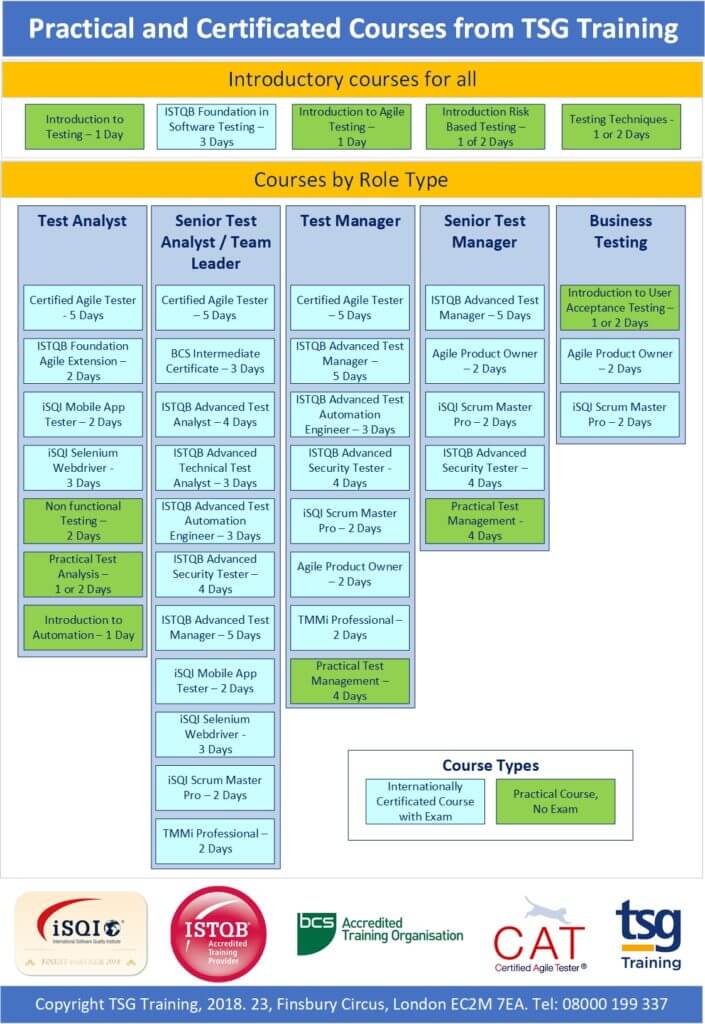
    The following table plots the relevant certificated and practical training courses that are recommended by software tester role.

    Software Testing - A roadmap to become a software tester
    A roadmap to become a software tester

    There is no doubt that ISTQB Software Testing Certification and iSQI Software Testing Certification schemes have moved the software testing world on in terms of maturity, approach and success, but it is important that the right blend of training is provided based on career stage, software testing role and corporate need be considered. The following table plots the relevant certificated and practical training courses that are recommended by software tester role.

    From the diagram, we can plot a route for certification that begins with ISTQB Foundation level, and which leads on to ISTQB Advanced Certifications, Agile Certifications and multiple choices to build both individual and organisational capability.

    Why Train and Certify

    Systems development is clearly a very expensive business that is manned by expensive teams to deliver solutions for business that will keep it ahead of the competition.

    The responsibility of the tester is both wide-reaching and key to success. Like professionals in other careers, such as Civil Engineering, Medicine and countless others we consider business critical, you would expect them to come with the right qualifications, right? That is, certified by their governing body to have reached a standard that you can rely on.

    In my experience of systems delivery, I have seen many development and maintenance programmes deliver 80% of what is needed for 150% of the budgeted cost; and in almost all instances the common-factor has been the lack of a professional software testing team or one that has not been listened to and isolated from key decision points. Why, when one considers IT spend on systems development and the cost of failure to business, would you risk have uncertified people overseeing your business-critical programmes? It is not a matter of what software testing training costs, but what it costs not to do it.

    Don’t get left behind: Decent software testing that yields results needs investment in training.

  • Successful Test Engineering and The ISTQB Programme for Professional Capability Development  | Benefits for Professionals and Employers

    Successful Test Engineering and The ISTQB Programme for Professional Capability Development | Benefits for Professionals and Employers

    The ISTQB Programme in Depth

    The ISTQB programme has been developed with the needs of today’s complex systems and delivery methods firmly in mind. With over one million certifications to date, it is, without doubt, the leading global certification scheme in the field of software testing.

    ISTQB® established, and continues to evolve, the internationally recognized Certified Tester scheme, which is a portfolio of certifications that develop, extend, and validate testing skills. The scheme is built around syllabi created by a global network of experts, the ISTQB® Glossary, sample exams, and the Testing Body of Knowledge (TBOK).

    The Certified Tester Foundation Level certification provides testing professionals with essential terminology and a breadth of knowledge. It is the prerequisite to the other modules within the scheme which offer depth and specialization.

    1. The “Core” stream modules are valid for any technology/ methodology/ application domain and build on the Foundation Level.
    2. The “Agile” stream focuses on testing practices specifically for the Agile methodology.
    3. The “Specialist” stream provides a deep dive into areas which may be based on quality characteristics, specific test approaches and test activities, or which cluster testing know-how for certain industry domains.

    Benefits for Professionals

    ISTQB® is the international standard in the field of software testing certification. Whether you are just getting started in a career in testing or have been in the field for a number of years, earning an ISTQB® certification offers significant benefits:

    • An independent, internationally recognized validation of skills that employers trust;
    • Portable proof of ability for both current and future employment;
    • Career progression support through the advancement of testing skills;
    • Enhanced professional credibility (certificate holders have authorized use of the applicable ISTQB® “Certified Tester” logo)

    “Would you recommend ISTQB® certification to your colleagues?”

    ISTQB Recommendation

    (Source:ISTQB® Effectiveness Survey 2020

    Benefits for Employers

    ISTQB® certification offers significant benefits to employers by supporting recruitment, retention, and development of testing professionals within the organization:

    • Competitive advantage by giving clients greater confidence in your business through a higher level of reliability of the applications being developed due to efficient and cost-effective testing practices;
    • Consulting companies with certified staff can offer higher-level services to customers, increasing revenues and brand value;
    • Common language and understanding of testing throughout the organization to improve collaboration and working practices;
    • Access to the ISTQB® Partner Program.

  • Top Microsoft Azure AI Tools To Boost Your Work

    Top Microsoft Azure AI Tools To Boost Your Work

    As we look to maximise our effectiveness with AI support, Microsoft Azure stands out with its comprehensive suite of AI tools designed to enhance productivity, streamline processes, and drive innovation.

    From deploying custom AI solutions to safeguarding online content, Azure provides a versatile range of services to cater to diverse needs. Here, we delve into the benefits of some of the most prominent Azure AI tools and how they can revolutionise your work.

    Azure AI Studio

    Azure AI Studio is a central hub for developing, training, and deploying AI models. It provides an integrated environment where developers can build custom AI solutions tailored to their specific needs. It takes users through the journey of solution creation, from modelling to deployment and monitoring.

    Benefits:

    • Centralised development: Streamlines the AI development process by providing a unified platform
    • Scalability: Easily scale models and solutions to meet growing demands
    • Flexibility: Supports various frameworks and languages, allowing for diverse application development

    Azure AI Metrics Advisor

    Azure AI Metrics Advisor is a service that helps monitor the performance and health of business metrics by automatically detecting anomalies and diagnosing their root causes. It uses machine learning to provide actionable insights, enabling quick responses to issues and informed decision-making.

    Benefits:

    • Proactive issue detection: Identifies anomalies in real-time, allowing for quick responses
    • Insightful analytics: Provides deep insights into metric deviations, aiding in root cause analysis
    • Customisable thresholds: Set custom thresholds to fine-tune detection sensitivity

    Azure AI Content Safety

    Azure AI Content Safety offers tools to monitor and moderate online content, ensuring safer and more pleasant user interactions. It uses advanced AI to detect and filter harmful or inappropriate content across text, images, and videos. Azure AI Content Safety helps businesses maintain safe and compliant environments by automatically flagging content that violates policies or standards.

    Benefits:

    • Automated moderation: Reduces the need for manual content review, saving time and resources
    • Comprehensive coverage: Supports image, text, and video content moderation
    • Enhanced user experience: Ensures that online platforms remain safe and welcoming for all users

    Azure AI Video Indexer

    Azure AI Video Indexer analyses video content to automatically extract insights such as spoken words, faces, emotions, and objects. It generates detailed metadata, making searching, navigating, and understanding large video libraries easier.

    Benefits:

    • Rich metadata extraction: Identifies key elements such as speech-to-text, facial recognition, and sentiment analysis
    • Enhanced searchability: Makes media content more searchable and accessible
    • Multilingual support: Analyses content in multiple languages, broadening its applicability

    Azure AI Bot Service

    Azure AI Bot Service enables the creation, deployment, and management of intelligent bots that can interact with users through various channels, such as websites, apps, and messaging platforms. It leverages AI to understand natural language, providing personalised and efficient responses to user queries.

    Benefits:

    • Multichannel integration: Connects bots with platforms like Microsoft Teams, Slack, and Facebook Messenger
    • Advanced NLP: Utilises natural language processing to improve interaction quality
    • Customisable: Tailors bots to meet specific business needs and workflows

    Azure AI Search

    Azure AI Search is a powerful search-as-a-service solution that integrates AI capabilities to deliver relevant and personalised search experiences. It enables businesses to index, search, and analyse their data quickly, providing rich, actionable insights and improving user interactions.

    Benefits:

    • High relevance: Provides highly relevant search results through AI-driven indexing
    • Customisable: Allows customisation of search experiences to fit specific use cases
    • Scalable: Handles large volumes of data, ensuring fast and accurate searches

    Azure Databricks

    Azure Databricks is a collaborative Apache Spark-based analytics platform optimised for Azure. It is designed to streamline big data and AI workflows. It enables data engineers, data scientists, and business analysts to build and deploy data solutions collaboratively at scale.

    Benefits:

    • Scalable processing: Handles large datasets efficiently
    • Collaborative workspace: Facilitates collaboration between data engineers, data scientists, and business analysts
    • Integrated ML: Integrates seamlessly with Azure Machine Learning for end-to-end machine learning workflows

    Azure Machine Learning

    Azure Machine Learning provides a comprehensive platform for building, training, and deploying machine learning models. It empowers data scientists and developers with robust tools to accelerate experimentation, improve model accuracy, and manage the end-to-end machine learning lifecycle.

    Benefits:

    • End-to-end management: Manages the entire ML lifecycle, including data preparation, model training, and deployment
    • Scalability: Provides scalable compute resources to handle large ML workloads
    • Automated ML: Offers automated machine learning capabilities to speed up model development

    Azure AI Services

    Azure AI Services offers a suite of pre-built APIs and tools that enable developers to integrate advanced AI capabilities into their applications. These services cover various domains such as vision, speech, language, and decision-making, facilitating the creation of intelligent and interactive solutions.

    Benefits:

    • Pre-trained models: Utilises pre-trained AI models for quick integration
    • Wide range of capabilities: Includes vision, speech, language, and decision-making APIs
    • Customisable: Allows customisation of models to meet specific business requirements

    Azure AI Immersive Reader

    Azure AI Immersive Reader enhances reading comprehension by providing tools that read text aloud, translate languages, and break down complex sentences. It is designed to support diverse learners by making content more accessible and engaging across various applications and platforms.

    Benefits:

    • Enhanced accessibility: Supports users with reading disabilities by providing tools like text-to-speech and reading comprehension aids
    • Customisable Experience: Allows users to adjust text size, font, and background colour for a personalised reading experience
    • Integration: Easily integrates with existing applications to enhance their accessibility features

    Azure AI Anomaly Detector

    Azure AI Anomaly Detector automatically identifies irregularities in time series data using advanced machine learning algorithms. It helps businesses quickly detect and respond to unexpected changes, ensuring the reliability and stability of their operations.

    Benefits:

    • Real-time detection: Identifies anomalies in real-time, enabling swift corrective actions
    • Custom sensitivity: Customizable sensitivity levels to suit different use cases
    • Seamless integration: Easily integrates with other Azure services for comprehensive monitoring solutions

    Maximise Microsoft Azure at work

    Make the most of the benefits that Azure’s AI tools can bring by staying ahead of the curve with our Microsoft Azure training courses.