Blog

  • What Are The Biggest ITSM Trends For 2024?

    What Are The Biggest ITSM Trends For 2024?


    In the ever-evolving landscape of IT Service Management (ITSM), 2024 is set to see transformative trends and continuous improvement for the industry.
    ITSM, the discipline focused on designing, delivering, managing, and improving how information technology (IT) is used within an organisation, is witnessing a paradigm shift. As new technologies and methodologies mature, such as AI and ML, they bring both opportunities and challenges.
    For IT professionals, staying ahead of these trends is not just about keeping pace with technological advancements but also about leveraging them to drive efficiency, enhance user experience, and secure a competitive edge. So, what trends can we expect to prepare for as we look towards 2024?

    AI and Machine Learning Integration

    It is perhaps no surprise that Artificial Intelligence (AI) and Machine Learning (ML) will continue to dominate the industry in 2024. AI’s role within ITSM processes opens the possibility of automating and optimising a plethora of tasks. This could include auto-routing service requests to employing chatbots for initial customer interactions; AI is streamlining operations and significantly reducing the workload on IT staff.
    Furthermore, ML’s prowess in predictive analytics may prove to be a game-changer for some organisations. By analysing patterns in historical data, ML algorithms can anticipate potential system disruptions, enabling IT teams to mitigate issues before they escalate. This predictive capability transforms ITSM from a traditionally reactive domain into a proactive one, where problems are addressed before they impact end-users.

    SLAs to XLAs

    2024 sees a significant paradigm shift in ITSM from the traditional Service-Level Agreements (SLAs) to Experience-Level Agreements (XLAs). This transition signifies a deeper commitment to the end-user experience rather than just meeting baseline service metrics. XLAs emphasise the actual satisfaction and productivity of users when interacting with IT services, going beyond mere uptime or response times.
    This shift is driven by the recognition that positive user experiences directly correlate with higher productivity, increased loyalty, and improved brand perception. By adopting XLAs, organisations commit to continuously improving the user journey, considering factors such as ease of use, accessibility, and personalisation.
    Heading into 2024, XLAs will create a nuanced approach to service delivery involving regular user feedback, monitoring of user satisfaction metrics, and a culture prioritising user experience in every aspect of IT service management. It’s a holistic approach requiring collaboration across departments and a user-centric mindset.

    Increased Emphasis on ITSM Security

    While cybersecurity already has a significant focus, it will continue to become an integral pillar of ITSM. There is a heightened emphasis on ITSM security driven by the need to protect critical IT infrastructure and sensitive data from breaches that can have far-reaching consequences.
    As we head into 2024, it is important for organisations to adopt a more holistic approach, embedding security protocols into every layer of their ITSM processes. This includes regular security audits, adherence to compliance standards, and incorporating security best practices in incident management, problem management, and change management processes.
    As we progress into 2024, the focus on ITSM security is not just about safeguarding against external threats but also about building a resilient IT ecosystem that can swiftly adapt and respond to any security challenge.

    Embracing Agile and Lean ITSM

    As we move into 2024, adopting Agile and Lean methodologies in IT Service Management (ITSM) has become increasingly prevalent. These methodologies, rooted in principles of flexibility, efficiency, and continuous improvement, are reshaping the ITSM landscape.
    Agile ITSM introduces adaptability and speed, enabling organisations to respond swiftly to changing user needs and market dynamics. It emphasises collaboration, iterative progress, and customer feedback, leading to more customer-centric IT services.
    Lean ITSM, on the other hand, focuses on value creation and eliminating waste. It encourages a systematic approach to streamlining processes, optimising resource utilisation, and enhancing service delivery.
    Together, Agile and Lean ITSM foster a culture of continuous improvement and innovation, creating greater flexibility and responsiveness in their IT services.

    Sustainability in ITSM

    As environmental concerns remain in the spotlight, sustainability in ITSM has become a critical focus area in 2024. Organisations are integrating sustainable practices into their ITSM operations, aiming to reduce their carbon footprint while enhancing efficiency.
    This involves adopting green IT initiatives, such as energy-efficient data centres, e-waste management, and sustainable procurement policies. Additionally, there’s a growing trend towards cloud-based services and virtualisation technologies, which not only reduce hardware dependency but also contribute to energy conservation.
    By incorporating sustainable practices into ITSM, organisations are not only contributing to environmental preservation but also aligning with broader corporate social responsibility (CSR) goals and regulatory requirements.

    Personalisation of IT Services

    The personalisation of IT services is a burgeoning trend as we progress to 2024, reflecting a shift towards a more individual-centric approach. For organisations, it’s about recognising that one size does not fit all; ITSM is adapting to cater to the unique needs and preferences of each user.
    Techniques such as user profiling, predictive analytics, and AI-driven recommendations enable ITSM teams to provide tailored support and services. This not only enhances user satisfaction but also improves the overall efficiency of IT services by addressing specific user requirements and challenges.
    The trend towards personalisation underscores the importance of understanding and meeting the diverse needs of users in today’s dynamic IT landscape.

    Moving Towards ITSM In 2024

    As we conclude our exploration of the ITSM landscape in 2024, it is evident that the field is undergoing a significant transformation. The trends we’ve seen, from AI and machine learning integration to the personalisation of IT services, represent not just technological advancements but a shift in the very ethos of IT service delivery.
    For IT professionals, adapting to these trends is not just beneficial – it’s imperative. Embracing these changes will not only enhance service management capabilities but also drive business success in an increasingly digital world. The future of ITSM is dynamic and promising, and those who navigate these trends skilfully will lead the way in defining the standards of IT excellence.

  • Top Software Testing Trends To Follow In 2024

    Top Software Testing Trends To Follow In 2024


    No two days are the same for those in the software testing industry. It’s an ever-changing landscape with new processes, ideas and opportunities appearing every day. When testers stay ahead of the game, they have an opportunity to learn and develop themselves – but also find efficiencies and improvements in their work too.
    With the software testing landscape changing regularly, it can be hard to know which new ideas to follow and adopt. To help navigate this, we’re sharing the top software testing trends for 2024 so you can get ahead for the year to come.

    Shift-Left and Shift-Right Testing

    With quality being at the forefront for software as we move to 2024, there is a growing rise of shift-left and shift-right testing to help provide the quality assurance that software needs.
    Shift-left testing is a software testing approach that involves testing the software products as early as possible in the development cycle, preferably in the design or requirement phase. Shift-left testing helps software testers identify and prevent defects before they become costly and difficult to fix.
    Also, shift-left testing helps software testers collaborate more closely with developers, business analysts, and customers and ensure that the software products meet the expectations and needs of the end-users.
    On the other hand, shift-right testing is a software testing approach that involves testing the software products after they are deployed in the production environment. Shift-right testing helps software testers monitor and evaluate the performance, reliability, usability, and security of the software products in real-world scenarios.
    This type of testing also helps software testers collect feedback from the end-users, identify issues not detected in the pre-production stages, and implement continuous improvement.

    DevOps, Agile, and Continuous Testing

    We know software testing is a field that requires speed, and that is why DevOps continues to grow in popularity. DevOps is a software development methodology that aims to shorten the development cycle and deliver software products faster and more frequently.
    Combined with Agile, DevOps and Agile create a cycle of ‘quality of speed’, helping to not only develop software faster but increase the quality of software with the practices, rules and processes that DevOps creates.
    Going into 2024, there will be a growing trend looking towards DevOps and Agile and a vital component of this – continuous testing. Continuous testing is a critical area of DevOps, as it ensures that the software products are tested continuously throughout the development process, from planning to deployment.
    With continuous testing, it enables software testers to detect and fix bugs early, reduce risks, improve quality, and increase customer satisfaction. In an Agile space, continuous testing can help to refine software using the iteration process in the Agile project format. With speed being of the essence for software, as we move into 2024, this link between continuous testing, DevOps and Agile becomes a strong trend. See how to transform your software testing into Agile Projects with our UKITB course.

    (More) Test Automation

    While test automation is not a new trend in software testing, it is becoming more important and prevalent. With the rise of AI and machine learning and continued growth in 2024, test automation can reduce human intervention by using software tools or scripts to perform testing tasks.
    Research from a 2021-2022 report found that most firms only use automated testing at 20% of current capacity. While this has undoubtedly grown in 2023, there is still a clear intention to develop this in 2024. So much so that a third of companies are looking to automate between half and three-quarters of their testing process, and around 20% of organisations want to automate more than 75% of their test process.
    One of the main benefits of test automation is that it can help to loosen the bottleneck of software testing. It can help software testers save time, effort, and resources, increase test coverage, improve test accuracy, enhance test consistency, and accelerate test delivery.
    Furthermore, as time goes on, test automation can support tests with the increasing complexity and diversity of software products, such as web applications, mobile applications, cloud applications, microservices and IoT devices.
    Whilst we can expect test automation to be a dominant trend in 2024, there are still challenges ahead. Test automation still requires careful planning, design, implementation, maintenance, and evaluation. Furthermore, automation doesn’t eliminate the need for manual testing either. However, as we look to 2024, we can expect more advanced automation tools and methods to support software testers better. If you’re looking for support in getting to grips with the growing trend of test automation, TSG Training offers specific automation training.

    Artificial Intelligence and Machine Learning

    Artificial intelligence (AI) and machine learning (ML) are not new concepts in software testing, but they are becoming more advanced and widely used and will continue to be a trend in 2024. AI and ML can help software testers automate tedious and repetitive tasks, such as test case generation, test execution, test data creation, bug detection, and bug reporting.
    AI and ML can also help software testers perform more complex and intelligent tasks, such as test optimisation, test prioritisation, test coverage analysis, test maintenance, and test prediction. AI and ML can also enable software testers to perform testing in new domains, such as natural language processing, computer vision, speech recognition, and self-driving cars.

    User Experience Testing

    Another trend set to continue in 2024 is user experience (UX) testing. This is a type of software testing that focuses on how the end-users interact with the software products. UX testing aims to evaluate the usability, accessibility, functionality, aesthetics, emotions, satisfaction, and loyalty of the end-users. This can help software testers ensure that the software products provide a positive and engaging user experience that meets or exceeds the expectations of the end-users.
    UX testing can involve various methods and techniques depending on the context and objectives of the test. Some examples of UX testing methods are user interviews, surveys, feedback, personas, journeys, mockups, heuristic evaluation, cognitive walkthroughs, A/B testing, eye tracking and heat maps.
    So, as we look towards 2024, we can expect to see trends that work to speed up the testing processes while simultaneously assuring quality. With this in mind, we’ll see trends like the above, as well as integrated tools that can combine processes for efficiency in a vast range of testing environments to ensure quality across a range of settings to better improve the testing process.

  • The Best Ways To Improve Software Testing: From Planning To Reporting

    The Best Ways To Improve Software Testing: From Planning To Reporting


    In the fast-paced world of software development, software testers are focused on two main goals: to improve the quality and increase the speed of the process.
    When software isn’t properly tested, it can lead to huge implications. Problems with software later down the line can lead to issues such as poor user experience and security breaches, which can lead to a loss of customers, financial trouble and harm the brand’s reputation.
    This is why software testing is a crucial part of software development, as it ensures the quality, functionality, and reliability of the software product. However, software testing can also be challenging, time-consuming, and costly if not done properly. So, how can you improve software testing to not only improve quality but not impact the speed of testing? Here are some of the best ways to improve software testing from the planning stages right through the process to reporting.

    Top Ways To Improve Software Testing


    1. Focus on the goals

    The first thing to do before any software testing activities take place is to fully understand the goals of software testing. This means having a clear understanding of what needs to be tested, why it needs to be tested, and how it will be tested.
    With this, it’s possible to make a plan which prioritises testing the most risky or important features while potentially eliminating unnecessary testing exercises to focus on the goals and meet the expectations of the software.

    1. Agile or waterfall?

    The next step after outlining the plan and goals of software testing is to select the ideal testing methodology to follow. Agile is growing in popularity for software testers as it can be flexible and adaptive, which can be ideal for fast-paced testing environments. Alternatively, some software testing goals may prefer a more structured and sequential methodology, such as a waterfall methodology.As well as selecting the right methodology, this is the step for choosing the right tools to use. Some tools may offer more features or support than others, such as test management, test automation, bug tracking, or performance testing tools.

    1. Upgrade your test plan

    A test plan is a document that describes the overall strategy and approach for software testing, including the scope, objectives, methodology, tools, resources, schedule, risks, and deliverables. In time-critical environments, it can be tempting to move through the test plan quickly or not create a plan at all, but the best way to improve software testing is by creating a detailed plan. Creating a detailed test plan will help to ensure the completeness and consistency of software testing, as well as facilitate the execution and reporting of the tests.
    Within this plan, make sure to think about the test case too. This is a set of steps and expected results that verify a specific functionality or requirement of the software product.

    1. Creating conducive environments

    A work environment that supports software testing can have a positive impact on the productivity, efficiency, and quality of the testing process. Some factors that can contribute to a conducive work environment include adequate equipment and infrastructure, comfortable and ergonomic workspace, clear and open communication channels, collaborative and supportive team culture, regular feedback and recognition, and continuous learning and improvement opportunities.
    There may be more formalised areas to improve, such as clearly defined roles in the testing team, to more fun-focused tasks, such as team-building exercises that boost communication.

    1. Automate testing

    Test automation can help to speed up testing and improve the quality of testing. However, currently, test automation has a relatively low adoption rate in organisations. Test automation uses software tools or scripts to perform repetitive or complex tests that would otherwise require manual intervention or human judgment.
    Test automation can offer many benefits for software testing, such as faster execution and feedback, higher accuracy and reliability, lower cost and effort, more comprehensive coverage and scalability, and easier maintenance and reuse. Test automation can be expensive to implement and does come with its own limitations, but combining both automated and manual testing can create better testing processes to improve both the speed and quality.

    1. Following best practice

    In a busy testing environment, it can always be tempting to cut corners and shave time off here and there. However, following best practices can often save time in the long run and can help to prevent errors from occurring, which require rework in the testing practice.
    Test automation can be more effective and efficient if some best practices are followed during its implementation and execution. Some of these best practices include;

    • Use a consistent naming convention and coding standard for test scripts
    • Organise test scripts into modular and reusable components
    • Use data-driven or keyword-driven approaches to separate test data from test logic
    • Adopting descriptive assertions and error-handling mechanisms to verify test results and handle exceptions
    • Use frameworks or libraries to simplify common or complex tasks
    • Have version control systems to manage test scripts and track changes
    • Implement continuous integration tools to run test scripts automatically after code changes

    · Generate reporting tools to create meaningful and actionable reports.

    1. Be creative

    Whilst planning and setting out a clear test plan is important to ensure the goals are met for the testing process, it can also be a good idea to get creative and explore ad-hoc testing during the process too. The idea is to be random and creative to look for potentially unusual scenarios or uncover defects that may not be found in conventional testing methods.
    Exploratory testing can be a fantastic process to adopt that can improve your software testing strategy and can help develop the intuition, imagination and experience of software testers.

    1. Embracing shift-left testing

    The shift-left approach involves testing early and often in the software development lifecycle. This proactive stance can detect defects earlier, reducing the overall cost and time spent on fixing issues. Per a report by Capgemini, organisations employing shift-left testing have seen a 22% reduction in time to market.

    1. Conducting regular code reviews

    Peer code reviews are vital in catching defects before the testing phase. Structured code reviews can detect up to 80% of code defects. Encouraging a collaborative environment for code review can significantly enhance software quality.

    1. Leveraging cloud-based testing platforms

    Cloud-based testing offers scalability, flexibility, and access to a wide range of testing environments. It can significantly reduce infrastructure costs and setup time. Research forecasts the cloud testing market size to grow from $6.5 billion in 2020 to $11.6 billion by 2025, indicating a rising adoption rate.

    1. Generate comprehensive reports

    Test reports are documents that summarise the results and outcomes of software testing, such as test objectives, test scope, test methodology, test tools, test execution, test results, test analysis, test evaluation, test conclusions, test recommendations, or test lessons learned. Test reports can communicate and demonstrate the quality and status of the software product to the testing team or other stakeholders, as well as provide valuable information and insights for future improvement or decision-making.

    1. Staying up to date with the latest testing trends

    The testing landscape is continuously evolving. Staying abreast of the latest tools and trends is vital for testers. At TSG Training, we offer regular blog posts, webinars and refresh our training courses regularly to ensure our knowledge stays ahead of the curve when it comes to software testing.

    Improving your software testing

    The software testing landscape demands a dynamic and multifaceted approach to assure quality and dependability. By incorporating these 12 strategies, developers and testers can elevate their testing methodologies, culminating in more robust and successful software products. Embracing continuous improvement and innovation in testing practices is not just a pathway to software excellence but a strategic imperative in the competitive software development industry.

  • The Link Between Business Analysis and Sustainability

    The Link Between Business Analysis and Sustainability

    Sustainability is no longer just a corporate buzzword. It is a business imperative that drives innovation, efficiency, and long-term growth. Today, professionals across industries are discovering how business analysis and sustainability are deeply connected.

    A Business Analyst does more than improve workflows and processes; they help organisations align strategic goals with sustainable practices. By collecting and analysing data, Business Analysts identify areas where businesses can reduce waste, improve efficiency, and create lasting value for both the company and the planet.


    Why Sustainability Is So Important

    Sustainability in business analysis is not just about tackling global challenges like climate change or resource scarcity. It is about ensuring the long-term success and resilience of an organisation.

    Investors and consumers increasingly expect companies to prove that they act responsibly. Many now evaluate businesses on their environmental, social, and governance (ESG) performance, looking at carbon footprints, diversity, ethical sourcing, and community engagement.

    Businesses with strong sustainability credentials often enjoy lower costs, greater brand loyalty, and higher investor confidence. In other words, doing good is also good for business.


    How Business Analysis Supports Sustainability

    Business analysis and sustainability are closely linked through data, strategy, and process improvement. Business Analysts use their skills to bridge the gap between high-level sustainability goals and practical implementation.

    Here are a few key ways Business Analysts drive sustainability initiatives:

    • Identifying inefficiencies in business processes that contribute to waste or emissions

    • Analysing data to track energy use, production efficiency, or supply chain sustainability

    • Helping design systems that reduce environmental impact and improve transparency

    • Aligning business objectives with ESG targets and regulatory requirements

    During the Business Analysis World Italy event, professionals explored the circular economy, sustainability in action, and the human factors behind sustainable business transformation. These conversations reinforced how essential analytical thinking is in driving a sustainable future.

    If you want to contribute to positive change, becoming a certified Business Analyst through TSG Training’s Business Analysis courses is an excellent place to start.


    What Sustainability Means in Business

    Sustainability in business means operating in a way that does not harm the environment, society, or the economy. A sustainable business strategy focuses on creating value today without compromising the ability of future generations to do the same.

    Key areas of focus include:

    • Reducing environmental impact and carbon emissions

    • Promoting ethical and responsible business practices

    • Supporting social equality and community wellbeing

    • Using innovation to solve global challenges

    When organisations integrate sustainability into their decision making, they not only protect the planet but also future-proof their operations against changing regulations and consumer expectations.


    Factors That Influence Sustainable Decision Making

    A truly sustainable business considers multiple factors when planning and executing operations. These include:

    • Using sustainable materials during manufacturing

    • Sourcing renewable energy for facilities

    • Reducing emissions across the supply chain

    • Investing in education and community development

    • Monitoring data to evaluate sustainability performance

    Every decision counts. From procurement to customer delivery, Business Analysts help assess the sustainability impact of each stage and recommend data-backed improvements.


    How Companies Use Data to Achieve Sustainability

    Data is the foundation of any successful sustainability strategy. Business Analysts play a crucial role in gathering, interpreting, and presenting data that drives environmental and social initiatives.

    For example:

    • Healthcare organisations use real-time data to track global health responses.

    • City planners analyse traffic data to reduce congestion and air pollution.

    • Manufacturers monitor resource use to optimise production and minimise waste.

    By applying the same analytical principles to sustainability, businesses can measure progress, forecast demand, and make evidence-based decisions that protect both profits and the planet.

    To gain these analytical and problem-solving skills, explore the BCS Foundation Certificate in Business Analysis a globally recognised qualification offered by TSG Training.


    Business Analysis and the Circular Economy

    Moving from a linear economy, where resources are used once and discarded, to a circular economy is critical to sustainable growth. Business Analysts are instrumental in this shift.

    Through data analysis and process mapping, they help organisations:

    • Optimise material usage

    • Design products for reuse and recycling

    • Reduce waste through better resource management

    • Identify new revenue streams from sustainable innovation

    Currently, only a small portion of the global economy is circular, but Business Analysts can help change that by enabling smarter design and sustainable product lifecycles.


    The Role of Business Analysts in ESG and Sustainable Transformation

    As ESG (environmental, social, and governance) priorities grow, so does the need for professionals who can analyse and interpret sustainability data. Business Analysts provide the insight companies need to understand performance, manage compliance, and identify risks.

    By integrating sustainability metrics into business analysis, organisations can monitor their environmental impact and social responsibility in real time. This transparency builds trust with investors, employees, and consumers.

    You can strengthen your sustainability expertise with TSG Training’s Business Analysis Practice course, which helps professionals apply business analysis techniques to complex strategic challenges.


    Never a Better Time to Get Certified as a Business Analyst

    With global attention turning to sustainable business practices, there has never been a better time to gain certification as a Business Analyst.

    Businesses need professionals who can analyse data, manage change, and support sustainability initiatives effectively. Earning an accredited qualification demonstrates your ability to deliver value through both analysis and ethical leadership.

    TSG Training offers a comprehensive portfolio of Business Analysis courses, from foundation to advanced levels. Each course blends real-world case studies with exam preparation and expert instruction to help you succeed.

    You can also attend TSG Training’s free webinars to stay up to date with industry developments and explore the evolving relationship between business analysis and sustainability.


    Conclusion

    The link between business analysis and sustainability has never been more critical. Business Analysts are uniquely positioned to help organisations understand their environmental impact, optimise processes, and implement sustainable strategies.

    Whether you are an aspiring analyst or an experienced professional, now is the time to align your skills with the future of sustainable business.

    Explore TSG Training’s Business Analysis courses to start building a career that makes a positive difference.

  • Successful Test Engineering and  The ISTQB Programme for Professional Capability Development | The Specialist Stream

    Successful Test Engineering and The ISTQB Programme for Professional Capability Development | The Specialist Stream

    The Specialist Stream

    The Specialist Stream contains a number of units that have been developed specifically to address:

    • Non-functional Testing and its constituent parts;
    • Industry specific requirements;
    • Technical requirements.

    It differs from the other streams in that it is boundless on what it can achieve as new qualifications are launched to expand upon the three-points immediately above, where the other qualifications specifically address the functional, strategic and management aspects of testing and test management.

    Building on the principles taught at Foundation Level, the Specialist stream contains 11 key syllabi, each constructed to meet specific requirements beyond the functional aspect options:

    • Usability Testing, which looks at how systems are used, both in terms of flexibility and disability access.
    • Game Testing, which has been developed to manage the complications of distributed games in real time.
    • Gambling Industry Sector, developed specifically for organizations offering online betting, payment management, etc.
    • Automotive Software Tester, developed specifically to manage the increasing complication of software in cards, such as satellite navigation, infotainment and internal systems management.
    • AI Testing, developed to help testers plan and execute testing in the increasingly complex space of artificial Intelligence;
    • Acceptance Testing, addresses User Acceptance, contractual & Regulatory Testing I.e., do systems meet all acceptance criteria in order for them to be made ‘live.’
    • Security Tester, an increasingly complex aspect of IT, the syllabus has bene developed to build security in, rather than afterwards;
    • Performance Tester, which helps designers and specialists think about the performance of a system when made live and increased usage in the future;
    • Model Based Tester, which helps develop models for te4sting, rather than a simple functional approach.
    • Test Automation Engineer to help individuals build test automation strategies and frameworks.
    • Mobile Application Testing for specifics to meet the needs of mobile and tablet-based applications.

    People intending to sit and gain a certification in this stream will need to have obtained a certificate at Foundation level first.

    There is no interdependency between the certifications in this stream; although to attempt them requires a prior pass at Foundation Level (at any Version level).

    The Usability Tester

    The Usability Tester focuses on usability testing methods and approaches. It covers set up procedures from a usability, user experience, and accessibility, as well as relevant standards and risks.

    The syllabus addresses key subjects that include:

    • Basic Concepts;
    • Risks in Usability, User Experience and Accessibility;
    • Usability and Accessibility Standards;
    • Usability Reviews;
    • Usability Testing;
    • User Surveys;
    • Selecting Appropriate Methods
    • Summary of Roles and Responsibilities.

    The syllabus is shown on page 46, and can be further downloaded here. The exam is multiple choice, with 40 questions identical value, of which 26 must be answered correctly in 60-minutes to be awarded a pass.

    People sitting and passing an exam should expect the following business-based outcomes:

    • Understand the basic concepts of usability and usability testing;
    • Identify and classify the severity of usability risks and potential accessibility violations in a given product at any stage of a development cycle;
    • Cite relevant standards for usability, user experience, and accessibility and verify their implementation in a given product;
    • Set up procedures so that stated usability, user experience and accessibility goals may be verified in practice for a given product;
    • Design and monitor the implementation of a test plan for achieving stated usability, user experience and accessibility goals;
    • Explain the rationale, process and results of usability, user experience and accessibility evaluations to non-specialist stakeholders.

    ISTQB Usability Tester Syllabus

    Game Testing

    The Game Testing certification focusses on the understanding and skills needed to perform and manage testing on all levels in game projects. It covers the basic concepts of video and game testing as well as how to determine risks and goals for gaming software. It includes conceptually designing, implementing and executing game software tests, approaches to games testing (Game Testing Mechanics, Sound Testing, Graphics Testing and Localization) and recognizing games testing tools.

    The syllabus addresses key subjects that include:

    • Specificity of Game Testing;
    • Testing Game Mechanics;
    • Graphics Testing;
    • Sound Testing;
    • Game Level Testing;
    • Game Controllers Testing;
    • Localization Testing.

    The syllabus is shown on page 48, and can be further downloaded here. The exam is multiple choice, with 40 questions identical value, of which 26 must be answered correctly in 60-minutes to be awarded a pass.

    People sitting and passing an exam should expect the following business-based outcomes:

    • Describe basic concepts of video games and game software testing;
    • Determine risks, goals and game software requirements under the needs and expectations of stakeholders;
    • Conceptually design, implement and execute basic game software tests;
    • Know the approaches to game software testing and their purpose;
    • Recognize the tools supporting game testing;
    • Determine how testing activities align with the software development lifecycle and reduce the cost of developing and publishing video games.

    ISTQB Game Tester Syllabus

    Gambling Industry Sector

    The Gambling Industry Tester (CT-GT) certification covers the key concepts in the gambling industry, the gambling industry ecosystem, and the different test types common to the gambling industry. It includes aspects such as gambling industry compliance testing, fun factor or player perspective testing, math testing, audio testing, multiplayer testing, and interoperability testing.

    The syllabus addresses key subjects that include:

    • Introduction to the Gambling Industry;
    • The Gambling industry Ecosystems;
    • Testing in the Gambling Industry.

    The syllabus is shown on page 50, and can be further downloaded here. The exam is multiple choice, with 40 questions identical value, of which 26 must be answered correctly in 60-minutes to be awarded a pass.

    People sitting and passing an exam should expect the following business-based outcomes:

    • Promote efficient and effective communication by using a common vocabulary inside the gambling industry;
    • Understand specific quality attributes that require testing within the gambling industry;
    • Understand typical test practices by describing the standard software development and testing methodologies within the gambling industry;
    • Understand gambling hardware and software certification which is the main difference between the gambling industry and other industries;
    • Use established techniques for designing tests aligned with gambling specific needs;
    • Appreciate the importance of jurisdictions and regulatory bodies in the gambling industry.
    • In general, a Certified Foundation Level Gambling Industry Tester Specialist is expected to have acquired the necessary skills to working effectively within a Gambling Industry testing team and environment.

    Automotive Software Tester

    The Automotive Software Tester (CT-AuT) certification focuses on the specific requirements for “testing E/E systems” in the automotive environment on the basis of established standards (Automotive SPICE®, ISO 26262, AUTOSAR®, etc.). It also covers testing in virtual environments (including XiL), and automotive-specific static and dynamic test techniques.

    The syllabus addresses key subjects that include:

    • Introduction to Automotive Software Testing;
    • Standards for the Testing of E/E Systems;
    • Testing in a Virtual Environment;
    • Automotive Specific Static and Dynamic Test Techniques.

    The syllabus is shown on page 52, and can be further downloaded here. The exam is multiple choice, with 40 questions identical value, of which 26 must be answered correctly in 60-minutes to be awarded a pass.

    People sitting and passing an exam should expect the following business-based outcomes:

    • Collaborate effectively in a test team;
    • Adapt the test techniques known from the ISTQB® Certified Tester Foundation Level (CTFL®) to the specific automotive project requirements;
    • Consider the basic requirements of the relevant automotive standards (Automotive SPICE®, ISO 26262, etc.) and select suitable test techniques;
    • Apply the virtual test methods (e.g., HiL, SiL, MiL, etc.) in test environments.

    ISTQB Automotive Tester Syllabus

    Artificial Intelligence (AI) Testing

    Increasingly in demand and growing in importance t out everyday lives, AI Testing (CT-AI) certification extends understanding of artificial intelligence and/or deep (machine) learning, most specifically testing AI-based systems and using AI in testing.

    The syllabus addresses key subjects that include:

    • Introduction to AI;
    • Quality Characteristics for AI Based Systems;
    • Machine Learning (ML) Overview;
    • ML Data;
    • ML Functional Performance Metrics;
    • ML Neural Networks and Testing;
    • Testing AI-Based Systems – Overview;
    • Testing Ai Specific Quality Characteristics;
    • Methods and Techniques for Testing of AI-Based Systems;
    • Test Environments for AI-Based Systems;
    • Using AI for Testing.

    The syllabus is shown on page 54, and can be further downloaded here. The exam is multiple choice, with 40 questions of varying value totalling 47 points. 31 points be gained in 60-minutes to be awarded a pass.

    People sitting and passing an exam should expect the following business-based outcomes:

    • Understand the current state and expected trends of AI;
    • Experience the implementation and testing of a ML model and recognize where testers can best influence its quality;
    • Understand the challenges associated with testing AI-Based systems, such as their self-learning capabilities, bias, ethics, complexity, non-determinism, transparency and explainability;
    • Contribute to the test strategy for an AI-Based system;
    • Design and execute test cases for AI-based systems;
    • Recognize the special requirements for the test infrastructure to support the testing of AI-based systems;
    • Understand how AI can be used to support software testing.

    ISTQB Artificial Intelligence Tester Syllabus

    Acceptance Testing

    The Acceptance Testing (CT-AcT) certification focuses on the concepts, methods, and practices of collaboration between product owners/business analysts and testers in acceptance testing. It covers user acceptance testing (UAT), contractual and regulatory acceptance testing, as well as alpha and beta testing.

    The syllabus addresses key subjects that include:

    • Introduction and Foundations;
    • Acceptance Tests, Acceptance Criteria;
    • Business Process and Business Rules Modelling;
    • Acceptance Testing for Non-Functional Requirements.

    The syllabus is shown on page 56 and can be further downloaded here. The exam is multiple choice, with 40 questions identical value, of which 26 must be answered correctly in 60-minutes to be awarded a pass.

    People sitting and passing an exam should expect the following outcomes:

    For business analysts and product owners:

    • Contribute to an organization’s acceptance testing activities by participating in the acceptance test design phase and supporting the alignment of the product with the business requirements;
    • Contribute to an organization’s acceptance testing activities by participating in the acceptance test design phase and supporting the alignment of the product with the business requirements;
    • Contribute to the quality of the acceptance testing process, including validation and verification of produced artifacts.

    For testers:

    • Contribute to the definition of acceptance criteria during the requirements definition phase;
    • Collaborate efficiently with business analysts and other stakeholders during all acceptance testing activities:
    • Understand the business objectives, communicate with business units, and share common objectives for acceptance testing.

    ISTQB Acceptance Tester Syllabus

    Security Tester

    Increasingly important in today’s world of widespread online fraud and hacking, the Security Tester (CT-SEC) certification focuses on planning, performing, and evaluating security tests from multiple perspectives including risk, requirements, vulnerability, and human factors. It also covers security testing tools and standards.

    The syllabus addresses key subjects that include:

    • The Basis of Security Testing;
    • Security Testing Purpose, Strategy and Goals;
    • Security Testing Processes;
    • Security Testing Throughout the Software Lifecycle;
    • Testing Security mechanisms;
    • Human Factors in Security Testing;
    • Security Test Evaluation and Reporting;
    • Security Testing Tools;
    • Standards and Industry Trends.

    The syllabus is shown on page 58 and can be further downloaded here. The exam is multiple choice, with 48 questions of varying value totalling 80 points. 52 points need to be gained in 120-minutes to be awarded a pass.

    People sitting and passing an exam should expect the following business-based outcomes:

    • Plan, perform and evaluate security tests from a variety of perspectives – policy-based, risk-based, standards-based, requirements-based and vulnerability-based.
    • Align security test activities with project lifecycle activities.
    • Analyze the effective use of risk assessment techniques in a given situation to identify current and future security threats and assess their severity levels.
    • Evaluate the existing security test suite and identify any additional security tests.
    • Analyze a given set of security policies and procedures, along with security test results, to determine effectiveness.
    • For a given project scenario, identify security test objectives based on functionality, technology attributes and known vulnerabilities.
    • Analyze a given situation and determine which security testing approaches are most likely to succeed in that situation.
    • Identify areas where additional or enhanced security testing may be needed.
    • Evaluate effectiveness of security mechanisms.
    • Help the organization build information security awareness.
    • Demonstrate the attacker mentality by discovering key information about a target, performing actions on a test application in a protected environment that a malicious person would perform, and understand how evidence of the attack could be deleted.
    • Analyze a given interim security test status report to determine the level of accuracy, understandability, and stakeholder appropriateness.
    • Analyze and document security test needs to be addressed by one or more tools.
    • Analyze and select candidate security test tools for a given tool search based on specified needs.
    • Understand the benefits of using security testing standards and where to find them.

    ISTQB Security Tester Syllabus

    Performance Tester

    The Performance Testing (CT-PT) certification provides knowledge of the principal aspects of performance testing, including technical aspects, method-based aspects, and organizational aspects. Specifically pertaining to performance testing, it covers areas such as basic concepts, measurements, activities, tasks, and tools.

    The syllabus addresses key subjects that include:

    • Basic Concepts;
    • Performance Measurement Fundamentals;
    • Performance Testing in the Software Lifecycle;
    • Performance Testing Tasks

    The syllabus is shown on page 60 and can be further downloaded here. The exam is multiple choice, with 40 questions identical value, of which 26 must be answered correctly in 90-minutes to be awarded a pass.

    People sitting and passing an exam should expect the following business-based outcomes:

    • Understand the basic concepts of performance efficiency and performance testing;
    • Define performance risks, goals, and requirements to meet stakeholder needs and expectations;
    • Understand performance metrics and how to collect them;
    • Develop a performance test plan for achieving stated goals and requirements;
    • Conceptually design, implement, and execute basic performance tests;
    • Analyze the results of a performance test and state implications to various stakeholders;
    • Explain the process, rationale, results, and implications of performance testing to various stakeholders;
    • Understand categories and uses for performance tools and criteria for their selection;
    • Determine how performance testing activities align with the software lifecycle.

    ISTQB Performance Tester Syllabus

    Model Based Tester

    The Model-Based Testing (CT-MBT) certification focuses on an advanced test approach of using models for testing. It extends and supports classic test design techniques such as equivalence partitioning, boundary value analysis, decision table testing, state transition testing, and use case testing. It is an innovative approach to improve effectivity and efficiency of the test process.

    The syllabus addresses key subjects that include:

    • Introduction to Model Based Testing (MBT);
    • MBT Modelling;
    • Selection Criteria for Test Case Generation;
    • MBT Test Implementation and Execution;
    • Evaluating and Deploying an MBT Approach.

    The syllabus is shown on page 62 and can be further downloaded here. The exam is multiple choice, with 40 questions of identical value, of which 26 must be answered correctly in 60-minutes to be awarded a pass.

    People sitting and passing an exam should expect the following business-based outcomes:

    • Collaborate in a model-based testing team using standard terminology and established MBT concepts, processes and techniques;
    • Apply and integrate model-based testing in a test process;
    • Effectively create and maintain MBT models using established techniques and best practices of model-based testing;
    • Select, create and maintain test artifacts from MBT models considering risk and value of the features tested;
    • Support the organization to improve its quality assurance process to be more constructive and efficient.
    • In general, an ISTQB® Model-Based Tester has acquired the necessary skills to successfully contribute to MBT projects in a given context.

    ISTQB Model Based Tester Syllabus

    Test Automation Engineer

    The Test Automation Engineer (CT-TAE) certification focuses on the design, development, and maintenance of test automation solutions. It also covers the concepts, methods, tools, and processes for automating dynamic functional tests, and the relationship of those tests to test management, configuration management, defect management, software development processes, and quality assurance. Methods described are generally applicable across a variety of software life cycle approaches, types of software systems, and test types.

    The syllabus addresses key subjects that include:

    • Introduction and Objectives for Test Automation;
    • Preparing for Test Automation;
    • The Generic Test Automation Architecture;
    • Deployment Risk and Contingencies;
    • Test Automation Reporting and Metrics;
    • Transitioning Manual Testing to an Automated Environment;
    • Verifying the Test Automation Suite (TAS);
    • Continuous Improvement.

    The syllabus is shown on page 64 and can be further downloaded here. The exam is multiple choice, with 40 questions of varying value totalling 70 points. 49 points need to be gained in 90-minutes to be awarded a pass.

    People sitting and passing an exam should expect the following business-based outcomes:

    • Contribute to the development of a plan to integrate automated testing within the testing process;
    • Evaluate tools and technology for automation best fit to each project and organization;
    • Create an approach and methodology for building a test automation architecture (TAA);
    • Design and develop (new or modified) test automation solutions that meet the business needs;
    • Enable the transition of testing from a manual to an automated approach;
    • Create automated test reporting and metrics collection;
    • Manage and optimize testing assets to facilitate maintainability and address evolving (test) systems.

    ISTQB Test Automation Engineer Syllabus

    Mobile Application Testing

    The Mobile Application Testing (CT-MAT) certification provides an insight into methods, techniques, and tools a professional may use to test mobile applications. It covers the required mobile project activities, roles, methods, and methodologies.

    The syllabus addresses key subjects that include:

    • Mobile World – Business and Technology Drivers;
    • Mobile Application Test Types;
    • Common Test Types and Test Process for Mobile Application;
    • Mobile Applications, Platforms, Tools and Environments;
    • Automating the Test Execution.

    The syllabus is shown on page 66 and can be further downloaded here. The exam is multiple choice, with 40 questions of identical value, of which 26 must be answered correctly in 60-minutes to be awarded a pass.

    People sitting and passing an exam should expect the following business-based outcomes:

    • Understand and review business and technology drivers for mobile apps in order to create a test strategy;
    • Identify and understand the key challenges, risks and expectations associated with testing a mobile application;
    • Apply test types and levels specific to mobile applications;
    • Apply common test types, such as those mentioned in ISTQB® Certified Tester Foundation Level syllabus 2018, in the mobile specific context;
    • Carry out the activities required specifically for mobile application testing as part of the main activities of the ISTQB® test process;
    • Identify and use suitable environments and appropriate tools for mobile application testing;

    Understand methods and tools specifically to support mobile application test automation.

  • Successful Test Engineering and The ISTQB Programme for Professional Capability Development | The Agile Stream

    Successful Test Engineering and The ISTQB Programme for Professional Capability Development | The Agile Stream

    The Agile Stream

    The Agile stream contains only 3 units, but collectively they serve to fulfil the needs of foundation level agile testing through to the differing roles and aspects of a large, distributed agile project.

    Figure 17 – ISTQB Agile Stream

    Building on the principles taught at Foundation Level, the stream contains:

    • Agile Tester, which must be passed before venturing in the either of the higher-level certifications within the stream. Note: Holders of an IISTQB Foundation certificate at Version 4 or later need not obtain an Agile Tester certification before embarking on the other certifications in this stream.
    • Agile Technical Tester for those wishing to progress on a technical route, rather than management of larger agile projects.

    There is no interdependency between the two Agile Level Certifications; although to attempt them requires a prior pass at Foundation Level – Agile Tester or Foundation Level (Version 4 or above).

    The Agile Tester

    The syllabus addresses in detail:

    • Agile Software Development;
    • Findamental Agile Testing Principles & Processes;
    • Agile Training Methods, Techniques & Tools.

    The syllabus is shown on page 38, and can be further downloaded here. The exam is multiple choice, with at least 26 questions from 40 being answered correctly over 60-minutes.

    People sitting and passing an exam should expect the following business-based outcomes:

    • Collaborate in a cross-functional Agile team being familiar with principles and basic practices of Agile software development;
    • Adapt existing testing experience and knowledge to Agile values and principles;
    • Support the Agile team in planning test-related activities;
    • Apply relevant methods and techniques for testing in an Agile project;
    • Assist the Agile team in test automation activities;
    • Assist business stakeholders in defining understandable and testable user stories, scenarios, requirements, and acceptance criteria as appropriate;

    Work and share information with other team members using effective communication styles and channels.

    Agile Technical Tester

    The ISTQB® Advanced Level Agile Technical Tester (CTAL-ATT) certification provides a thorough introduction to the technical testing skills which are fundamental in organizations using an Agile development approach. These skills include testing and agile techniques, test automation approaches, and continuous deployment and delivery.

    The syllabus addresses in detail:

    • Agile Software Development;
    • Fundamental Agile Testing Principles & Processes;
    • Agile Training Methods, Techniques & Tools.

    The syllabus is shown on page 40, and can be further downloaded here. The exam is multiple choice, with 40 questions of variable value that offer a combined value of 64 points. The point pass mark is set at 42 over 90-munites to be awarded a pass.

    People sitting and passing an exam should expect the following business-based outcomes:

    • Apply Agile techniques to ensure tests that provide adequate coverage;
    • Define testable requirements within Agile Team;
    • Create and implement various Agile Test approaches using appropriate techniques;
    • Support and contribute to test automation activities in an Agile project;
    • Support continuous integration in an Agile Team;
    • Support Agile Team in continuous delivery and deployment;
    • Learn the service virtualization concepts;
    • Work with, and share information with, other team members using effective communication styles and channels.

    Agile Test Leadership at Scale

    The Agile Test Leadership at Scale (CTAL-ATLaS) certification focuses on how to organize and improve quality and testing across multiple teams in an agile organization. It also covers how to approach quality and testing at a strategic level in order to achieve higher business agility in an organization. CTAL-ATLaS covers how to scale testing and quality assurance efforts by fostering a quality mindset and culture across the organization. This includes shifting from a traditional test management approach typically used in sequential development models to a quality assistance approach which builds on Lean and Agile principles and values. It also includes how to adopt common Lean and Agile techniques and processes for analyzing and solving problems and how to use them to improve testing and quality in the organization.

    At the time of writing, ATLaS is being developed as a series of certifications that build into an overall certificate. At this time, it is advertised as being a ‘Minimal Viable Product (MVP)’ of several components for which an exam is available. People passing the exam now will be granted the full certification. As further products are added to ATLAS so will exams, and candidates will need to pass them all to be awarded the certification.

    The syllabus addresses in detail:

    • Quality Assurance;
    • Improve Quality and Flow in a Value-Driven Organization;
    • Continuous Improvement of Quality and Testing.

    The syllabus is shown on page 42, and can be further downloaded here. The ATLaS body of knowledge provides further reading here. The exam is multiple choice, with 15 questions of variable value that offer a combined value of 25 points. The point pass mark is set at 17 over 45-munites to be awarded a pass.

    People sitting and passing an exam should expect the following business-based outcomes:

    • Foster a value-driven quality mindset and culture.

    ISTQB Agile Test Leadership at Scale (ATLaS) Tester Syllabus

  • Successful Test Engineering and  The ISTQB Programme for Professional Capability Development | The ISTQB Programme in Depth

    Successful Test Engineering and The ISTQB Programme for Professional Capability Development | The ISTQB Programme in Depth

    The ISTQB Programme in Depth

    The ISTQB programme has been developed with the needs of today’s complex systems and delivery methods firmly in mind. With over one million certifications to date, it is, without doubt, the leading global certification scheme in the field of software testing.

    ISTQB® established, and continues to evolve, the internationally recognized Certified Tester scheme, which is a portfolio of certifications that develop, extend, and validate testing skills. The scheme is built around syllabi created by a global network of experts, the ISTQB® Glossary, sample exams, and the Testing Body of Knowledge (TBOK).

    The Certified Tester Foundation Level certification provides testing professionals with essential terminology and a breadth of knowledge. It is the prerequisite to the other modules within the scheme which offer depth and specialization.

    1. The “Core” stream modules are valid for any technology/ methodology/ application domain and build on the Foundation Level.
    2. The “Agile” stream focuses on testing practices specifically for the Agile methodology.
    3. The “Specialist” stream provides a deep dive into areas which may be based on quality characteristics, specific test approaches and test activities, or which cluster testing know-how for certain industry domains.

    The Core Stream

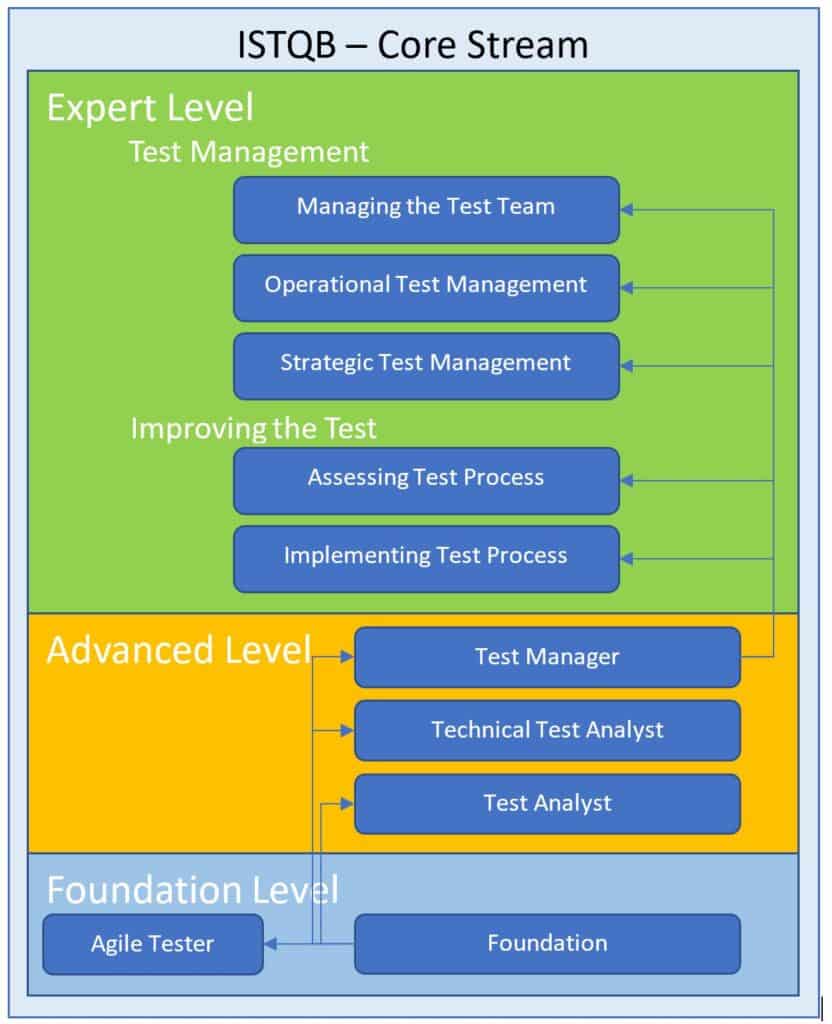
    The ‘Core Stream’ is designed to reflect modern test engineering principles, coupled with competencies that meet the needs of a Test Practice and varying development models, supported by capability from competent, multi-skilled individuals. The Core Stream provides mainstream competencies associated with test engineering in three different levels:

    1. Foundation – the ‘get you going’ level;
    2. Advanced for role specific competencies;
    3. Expert for those working at senior levels.
    The Foundation Level

    The Foundation level is about getting people and organizations into the common language of test engineering. It is the qualification on which all ISTQB syllabi for every other certification in the programme is based. That is, it provides the common terms, terminology and processes for test engineering.

    The Foundation level programme has traditionally been based upon two syllabi and qualifications:

    1. Foundation Tester; and
    2. Agile Tester.

    Foundation Tester

    Historically, this provided the basics of testing, processes, terms and terminology for projects that would typically be based around the waterfall, iterative and v-model life cycles. Holding this certificate allows people to progress to the Advanced and Specialist streams for further development.

    However, the Foundation level has undergone a recent transformation with the release this year of a new syllabus at Version 4. It is a radical departure from the 2018 syllabus and now addresses much around agile testing. This is the course that provides students with the common terms and processes they will need through their careers, and which are industry-recognised as the de facto standard.

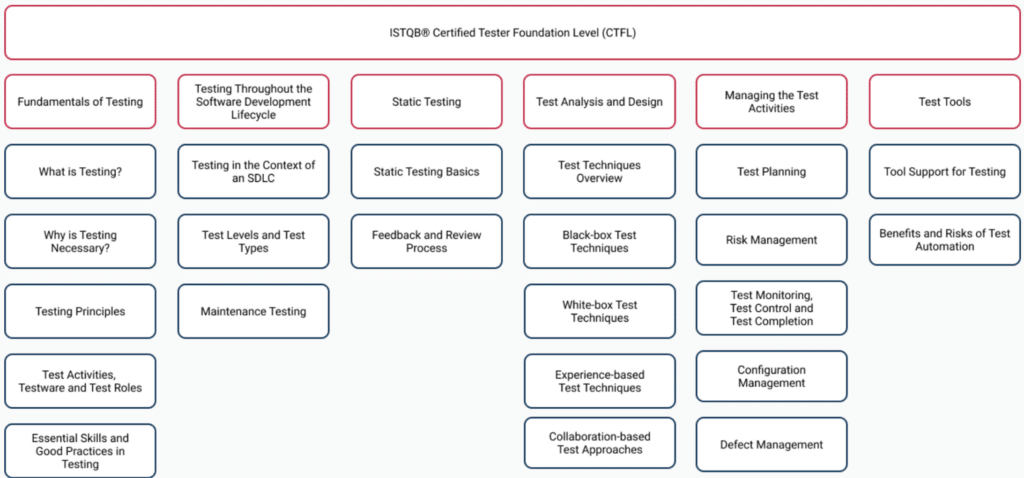
    The syllabus addresses in detail:

    • The Fundamentals of Testing;
    • Testing Throughout the Software Development Lifecycle;
    • Static Testing;
    • Test Analysis and Design;
    • Managing the Test Activities;
    • Test Tools.

    The syllabus and teaching in Foundation at version 4 is shown on page 13. The exam is multiple choice, with at least 26 questions from 40 being answered correctly over 60-minutes. A copy of the syllabus can be downloaded here.

    People sitting and passing an exam should expect the following business-based outcomes:

    • Understand what testing is and why it is beneficial;
    • Understand fundamental concepts of software testing;
    • Identify the test approach and activities to be implemented depending on the context of testing;
    • Assess and improve the quality of documentation;
    • Increase the effectiveness and efficiency of testing;
    • Align the test process with the software development lifecycle;
    • Understand test management principles;
    • Write and communicate clear and understandable defect reports;
    • Understand the factors that influence the priorities and efforts related to testing;
    • Work as part of cross-functional team;
    • Know risks and benefits related to test automation;
    • Identify essential skills required for testing;
    • Understand the impact of risk on testing;
    • Effectively report on test progress and quality.
    Agile Tester

    Agile is now mainstream, and students must be able to work within it. The course expands on the techniques and learning in the Foundation Course and the difference that Agile brings. This is an extension to the Foundation that addresses the needs of agile test engineers. People holding this certificate allows them to progress to the Agile stream for further development.

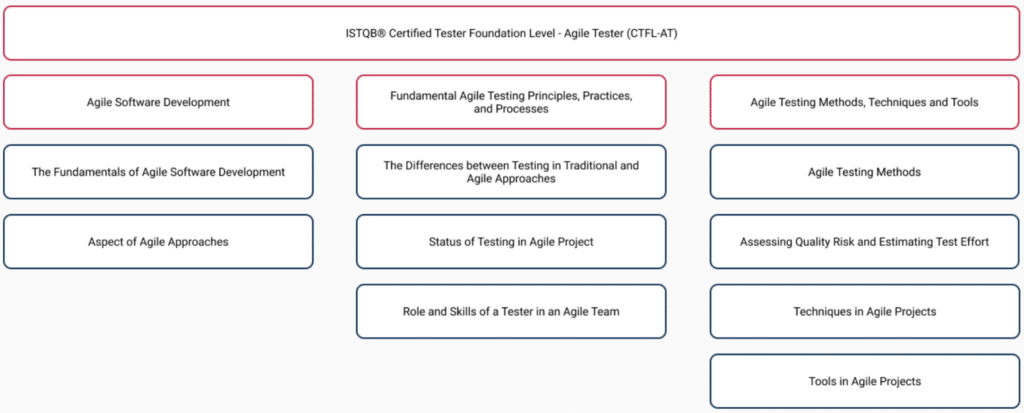
    The syllabus addresses in detail:

    • Agile Software Development;
    • Fundamental Agile Testing Principles & Processes;
    • Agile Training Methods, Techniques & Tools.

    The syllabus and teachings are shown on page 15. The exam is multiple choice, with at least 26 questions from 40 being answered correctly over 60-minutes. A copy of the syllabus can be downloaded here.

    People sitting and passing an exam should expect the following business-based outcomes:

    • Collaborate in a cross-functional Agile team being familiar with principles and basic practices of Agile software development;
    • Adapt existing testing experience and knowledge to Agile values and principles;
    • Support the Agile team in planning test-related activities;
    • Apply relevant methods and techniques for testing in an Agile project;
    • Assist the Agile team in test automation activities;
    • Assist business stakeholders in defining understandable and testable user stories, scenarios, requirements, and acceptance criteria as appropriate;
    • Work and share information with other team members using effective communication styles and channels.

    Important note for those wishing to progress to the Agile stream: People sitting a Foundation course and passing the exam at syllabus version 4 are now exempt from the requirement to sit an Agile Tester course and exam before advancing to the Agile stream. However, people who hold a Foundation certificate based upon the 2018 syllabus or earlier are required to sit the Agile Tester course or take a new foundation course at Version 4 before advancing to the Agile stream.
    The Advanced Level

    The Advanced Level supports people and organisations by taking them beyond the basics and principles established at Foundation Level. It is specifically for those who want to develop and specialise in testing in one of three role-based competencies, including:
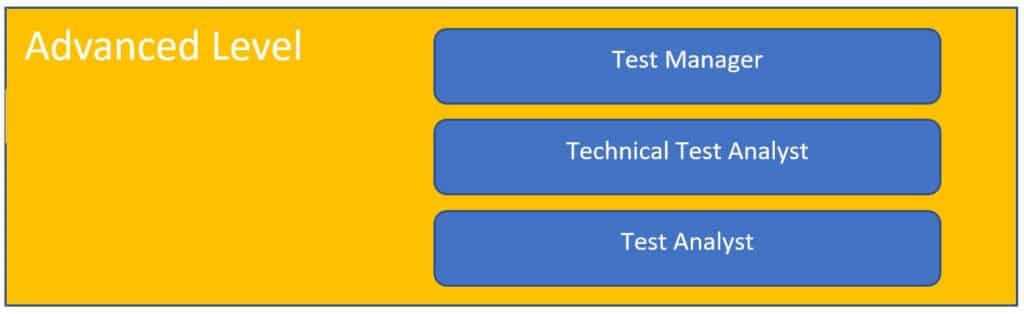
    There are significant business-based outcomes at this level (more later), but people entering this stream must first have sat and passed a Foundation Tester exam at Version 4 or earlier. There is no interdependency between the certificates; although one of the Analyst certificates is recommended prior to embarking on theTest Manager Certificate.

    Advanced Test Analyst

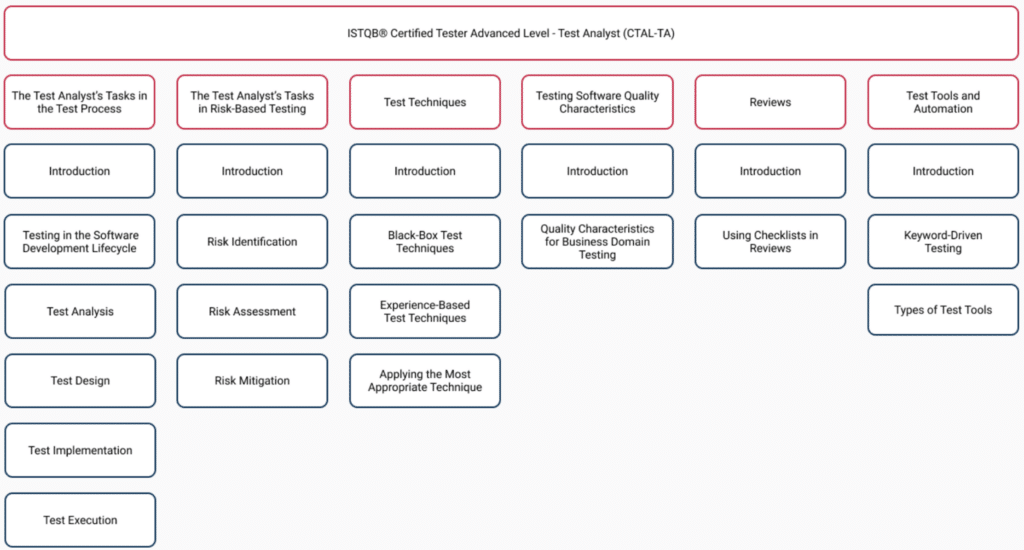
    The ISTQB® Advanced Level Test Analyst (CTAL-TA) certification provides the skills needed to perform structured and thorough software testing across the software development life cycle. It goes into detail about the test analyst’s role and responsibilities in every step of a standard test process and expands on important test techniques.

    The Advanced Level Test Analyst certification is aimed at people who wish to further develop their expertise in functional test analysis and test design techniques after 12-18 months of solid testing experience following passing Foundation. It addresses key subjects that include:

    • The Test Analyst’s Tasks in the Test Process;
    • The Test Analyst’s Tasks in Risk-Based Testing;
    • Test Techniques;
    • Testing Software Quality Characteristics;
    • Reviews;
    • Test Tools & Automation.

    The syllabus is shown pictorially on page 18 and a copy can be downloaded here. The exam is multiple choice, with 40 questions offering a combined value of 80 points. The point pass mark is set at 52 over 2-hours.

    People sitting and passing an exam should expect the following business-based outcomes:

    • Perform the appropriate testing activities based on the software development life cycle being used;
    • Determine the proper prioritization of the testing activities based on the information provided by the risk analysis;
    • Select and apply appropriate test techniques to ensure that tests provide an adequate level of confidence, based on defined coverage criteria;
    • Provide the appropriate level of documentation relevant to their testing activities;
    • Determine the appropriate types of functional testing to be performed;
    • Work effectively in a usability testing team;
    • Effectively participate in requirements / user story reviews with stakeholders, applying knowledge of typical mistakes made in work products;
    • Improve the efficiency of the test process with the use of tools.
    Advanced Technical Test Analyst

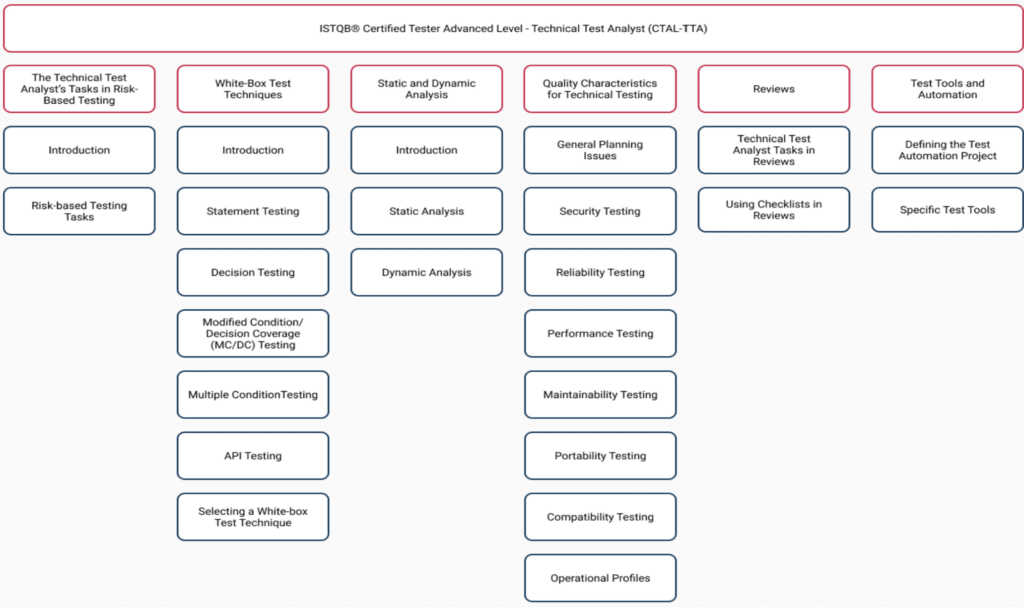
    The ISTQB® Advanced Level Technical Test Analyst (CTAL-TTA) provides a thorough introduction to the technical testing skills which are fundamental in many organizations today. These skills include risk-based testing, white box testing, static and dynamic analysis, non-functional testing, and test automation. Essentially, Technical Test Analyst concentrates on classes of testing that are not specifically intended for deep functional testing, but more on the operability of a system and its workings.

    The Advanced Level Technical Test Analyst certification is suitable for anyone who is involved in testing as well as anyone interested in further developing their software testing knowledge. This includes people performing activities such as test analysis, test consulting, and software development. It addresses key subjects that include:

    • Technical Test Analyst Tasks in Risk-Based Testing;
    • White-Box Techniques;
    • Static and Dynamic Analysis;
    • Quality Characteristics for Technical Testing;
    • Reviews
    • Test Tools & Automation.

    The syllabus is shown on page 20 and a copy can be downloaded here from the ISTQB website. The exam is multiple choice, with 45 questions of variable value that offer a combined value of 78 points. The point pass mark is set at 51 over 2-hours.

    People sitting and passing an exam should expect the following business-based outcomes:

    • Recognise and classify the typical risks associated with the performance, security, reliability, portability and maintainability of software systems;
    • Provide technical elements to the planning, design and execution of tests for mitigating performance, security, reliability, portability and maintainability risks;
    • Select and apply appropriate white-box test techniques to ensure that tests provide an adequate level of confidence, based on design coverage;
    • Effectively participate in reviews with developers and software architects applying knowledge of typical defects in the code and architecture;
    • Improve the quality characteristics of code and architecture by making use of different analysis techniques;
    • Outline the costs and benefits to be expected from introducing particular types of test automation;
    • Select appropriate tools to automate technical testing tasks;
    • Understand the technical issues and concepts in applying test automation.
    Advanced Test Manager

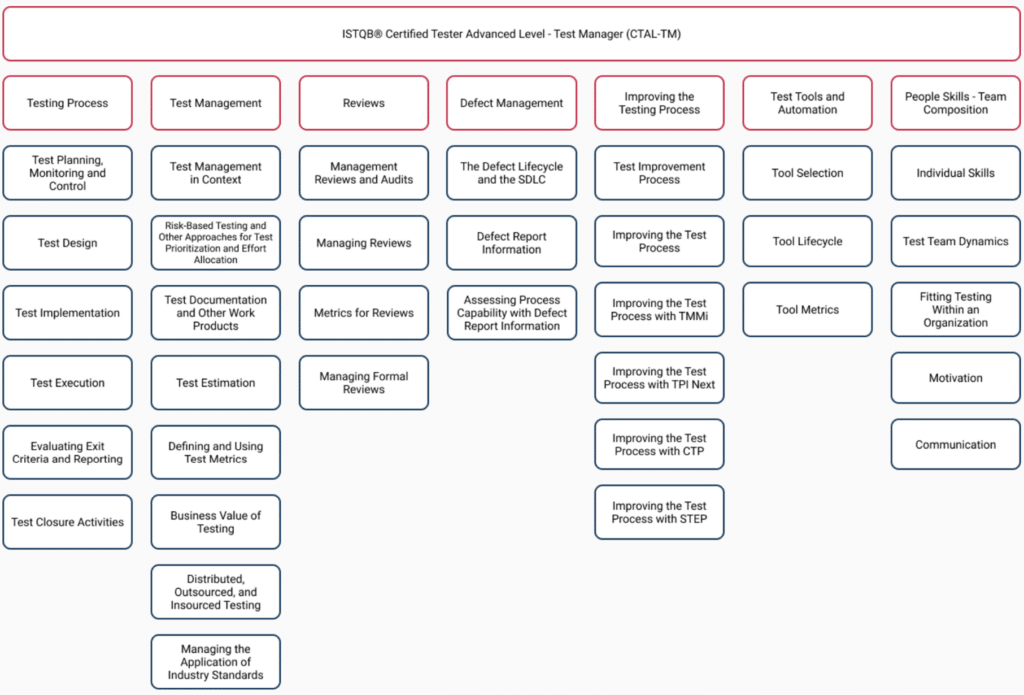
    The ISTQB® Advanced Level Test Manager (CTAL-TM) certification provides the knowledge and competencies to take responsibility for managing all the testing activities across the software development lifecycle. It covers everything from how to design a suitable test approach for the project based on the organizational test strategy to building a test team or testing competencies to complete the necessary testing.

    The Advanced Level Test Manager certification is aimed at people who have already achieved an advanced point in their careers in software testing and wish to develop further their expertise in test management. It addresses key subjects that include:

    • Testing Process;
    • Test Management;
    • Test Reviews;
    • Defect Management;
    • Improving the Test Process;
    • Test Tools and Automation;
    • People Skills & Team Composition.

    The syllabus is shown on page 22 and a copy can be downloaded from the website here. The exam is multiple choice, with 65 questions of variable value that offer a combined value of 115 points. The point pass mark is set at 75 over 3-hours.

    People sitting and passing an exam should expect the following business-based outcomes:

    • Manage a testing project by implementing the mission, goals and testing processes established for the testing organization;
    • Organize and lead risk identification and risk analysis sessions and use the results of such sessions for test estimation, planning, monitoring and control;
    • Create and implement test plans consistent with organizational policies and test strategies;
    • Continuously monitor and control the test activities to achieve project objectives;
    • Assess and report relevant and timely test status to project stakeholders;
    • Identify skills and resource gaps in their test team and participate in sourcing adequate resources;
    • Identify and plan necessary skills development within their test team;
    • Propose a business case for test activities which outlines the costs and benefits expected;
    • Ensure proper communication within the test team and with other project stakeholders;
    • Participate in and lead test process improvement initiatives.
    The Expert Level

    The Expert Level is aimed at the most senior test engineers who are tasked with operating strategically typically at group or organizational levels. They will be tasked with setting test engineering strategy, process, management and similar activities. People entering this stream will generally hold 10 or more years’ experience as a test engineer, with at least 2-years in specialist roles, such as Test Management, Process Definition, Maturity Assessment and other key tasks.
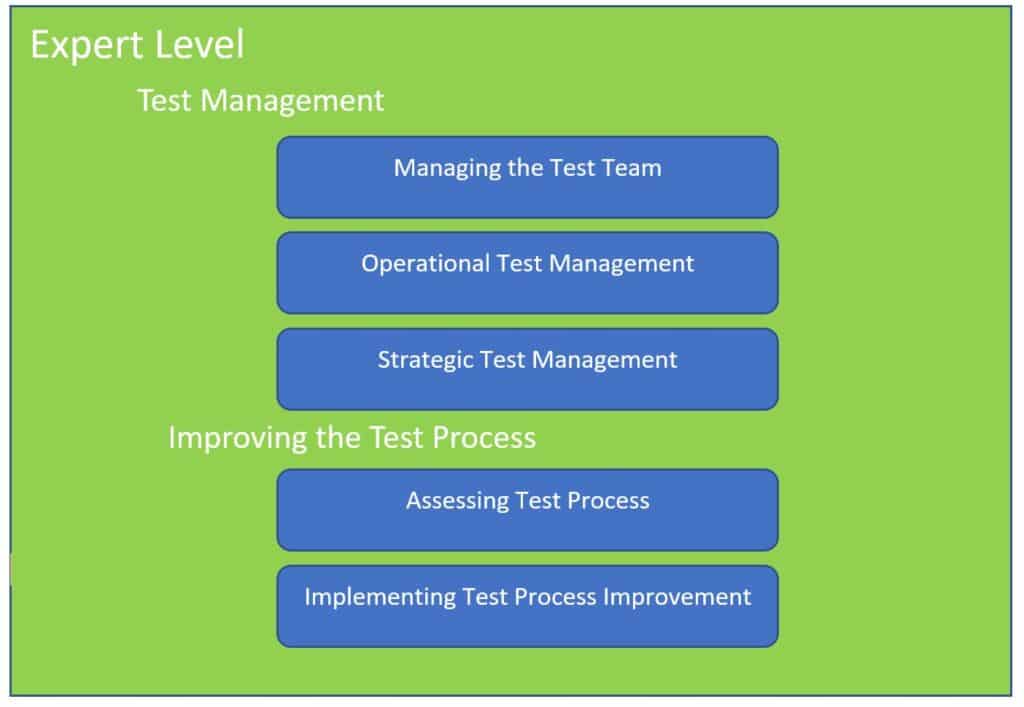
    This level is significant for organizations in that people who qualify from it will be able to undertake Test Assessments, Establish Maturity of People and Process against industrial models and, importantly, set the frameworks for the entire test engineering process and its operation. These are key assets for an organization that will pay dividends many times over the cost of investment.

    The Expert level comprises two-key subjects:

    1. Test Management, which involves passing all three management exams to be awarded an Expert Test Management certificate;
    2. Improving the Test Process, which involves passing Assessing Test Process and Implementing Test Process Improvement exams to be awarded an Expert certificate in Improving the Test Process.

    Certificates awarded are valid for a period of 7-years, following which an assessment must be undertaken to retain the certificate.

    People attempting to obtain a certificate at this level must first have sat and passed an Advanced Test Manager exam.

    The Expert Improving the Test Process

    The ‘Expert Improving the Test Process’ consists of two modules, both of contribute to the overall ‘Expert Improving the Test Process’ certificate. That is, a certificate is awarded only once both modules have been sat and a successful exam sat.

    Expert Assessing the Test Process

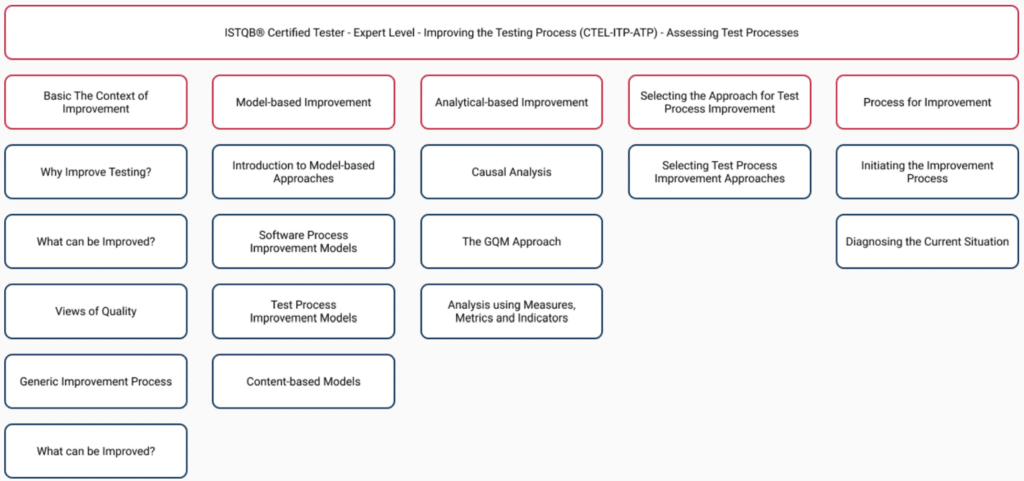
    Assessing the Test Process (CTEL-ITP-ATP) certification helps prepare individuals to fulfil the specific expert role within their organization or project, and more specifically to assess and advise on test process improvement. It covers the context of improvement, recognized models for improvement, analytic approaches, selection of an approach, and initiation of the process.

    It addresses key subjects that include:

    • The Basic Context of Improvement;
    • Model Based Improvement;
    • Analytical Based Improvement;
    • Selecting the Approach for Test Process Improvement;
    • Process for Improvement.

    The syllabus is shown on page 25 and can downloaded here. The pass mark is 65% for the exam, which has two parts:

    • Multiple choice over 45 minutes;
    • Written response over 90-munites;

    People awarded an overall Expert Improving the Test Process certificate should expect the following business-based outcomes:

    • Lead programme for improving the testing process within an organization or project and can identify and manage critical success factors;
    • Take appropriate business-driven decisions on how to approach improvement to the test process;
    • Assess the current status of a test process, propose stepwise improvements and show how these are linked to achieving business goals;
    • Set up a strategic policy for improving the testing process and implement that policy;
    • Analyse specific problems with the test process and propose effective solutions;
    • Create a test improvement plan which meets business objectives;
    • Develop organizational concepts for improvement of the test process which include required roles, skills and organizational structure;
    • Establish a standard process for implementing improvement to the test process within an organization;
    • Manage the introduction of changes to the test process, including co-operation with the sponsors of improvements;
    • Understand and effectively manage the human issues associated with assessing the test process and implementing necessary changes.

    This is part 1 of Improving the Test Process. For Part 2 of the CTEL-ITP certification, refer toExpert Implementing Test Process.
    Expert Implementing Test Process Improvement

    Implementing Test Process Improvement helps prepare individuals to fulfil the specific expert role within their organization or project, and more specifically to ensure that the implementation of test process improvements within their organization or project takes place effectively and stands the best chance of success.

    It covers the improvement process, organization considerations, change management, and success factors.

    It addresses key subjects that include:

    • Process for Improvement;
    • Organization, Roles & Skills;
    • Managing Change;
    • Critical Success Factors;
    • Adapting to Different Life Cycle Models.

    The syllabus is shown on page 27 and can be further downloaded here. The pass mark is 65% for the exam, which has two parts:

    • Multiple choice over 45 minutes;
    • Written response over 90-munites;

    People awarded an overall Expert Improving the Test Process certificate should expect the following business-based outcomes:

    • Lead programs for improving the testing process within an organization or project and can identify and manage critical success factors;
    • Take appropriate business-driven decisions on how to approach improvement to the test process;
    • Assess the current status of a test process, propose stepwise improvements and show how these are linked to achieving business goals;
    • Set up a strategic policy for improving the testing process and implement that policy;
    • Analyse specific problems with the test process and propose effective solutions;
    • Create a test improvement plan which meets business objectives;
    • Develop organizational concepts for improvement of the test process which include required roles, skills and organizational structure;
    • Establish a standard process for implementing improvement to the test process within an organization;
    • Manage the introduction of changes to the test process, including co-operation with the sponsors of improvements;
    • Understand and effectively manage the human issues associated with assessing the test process and implementing necessary changes.
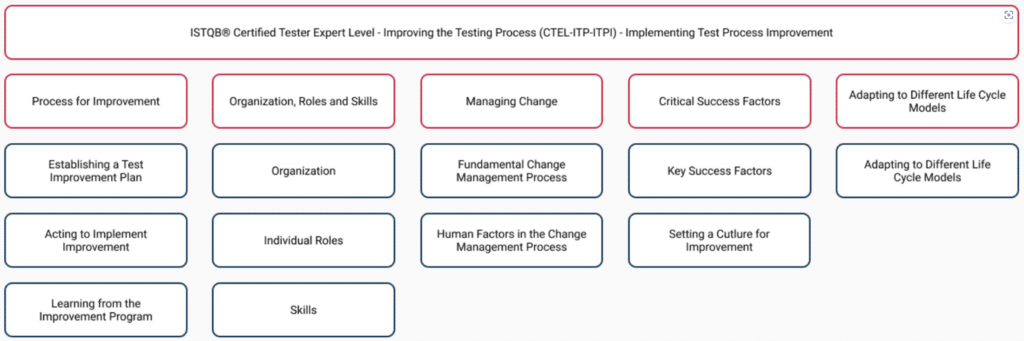
    The Expert Test Management Certification

    The ‘Expert Test Management’ consists of three modules, all of which contribute to the overall ‘Expert Test Management’ certificate. That is, a certificate is awarded only once all three modules have been sat and a successful exam sat.

    It is a complex certificate that examines the Test Manager’s capability to operate across the organizational spectrum to set:

    • Frameworks for Test Management;
    • Operating and executing large scale test programmes, such as major integrations following acquisitions, and similar;
    • Managing the test team to meet organization needs and those of people in their teams to increase their knowledge, capability and competence to grow and climb their own career ladder.
    • People passing all three exams are awarded an Expert Test Certificate that will be valid for 7-years, following which a further assessment is mandated to continue holding the certificate.

    Expert Strategic Test Management

    The ‘Strategic Test Management’ content within the overall, 3-part Test Management syllabus considers the purpose of testing or the test mission, and the relation between the test policy, the test strategy, and the test objectives.

    It addresses the effectiveness, efficiency, and satisfaction metrics for the test policy objectives. Integrating tools across the organization and testing as part of a larger set of quality management activities necessary to deliver quality software products and services are included, as well as the management of external relationships, most especially the merging of test strategies with third party organizations.

    This element of the qualification also looks at the test management considerations for different project lifecycle models.

    It addresses key subjects that include:

    • Test Missions, Policies, Strategies and Goals;
    • Managing External Relationships;
    • Managing Across the Organization;
    • Testing Considerations for Domain and Project Factors;
    • Evaluating Effectiveness and Efficiency.

    The syllabus is shown on page 30 and can be further downloaded here. The pass mark is 65% for the exam, which has two parts:

    • Multiple choice over 45 minutes;
    • Written response over 90-minutes;

    People awarded an overall Expert Test Management certificate should expect the following business-based outcomes:

    • Lead the test management within an organization, project or program to identify and manage critical success factors with management commitment at CEO/Board level;
    • Take appropriate business-driven decisions on a test management strategy and implement organization wide commitment and compliance based on quality KPIs;
    • Assess the current status of the test management, propose stepwise improvements and show how these are linked to achieving business goals within the organizational context of test management (organization or project/program);
    • Set up a strategic policy for improving the test management and the testing, and implement that policy in an organization;
    • Analyse specific problems with the test management and its alignment with other roles or management areas in the project/organization, and propose effective solutions;
    • Create a master test plan with matching governance dashboard to meet or exceed the business objectives of the organization or a project/program;
    • Develop innovative concepts for test management (project) organizations which include required roles, skills, methodologies (tools) and organizational structure;
    • Establish a standard process for implementing test management in an organization (project/program) with standardized delivery based on quality KPIs;
    • Lead an organization to improve the test management process and manage the introduction of changes;
    • Understand and effectively manage the human issues associated with test-project management and implement necessary changes.
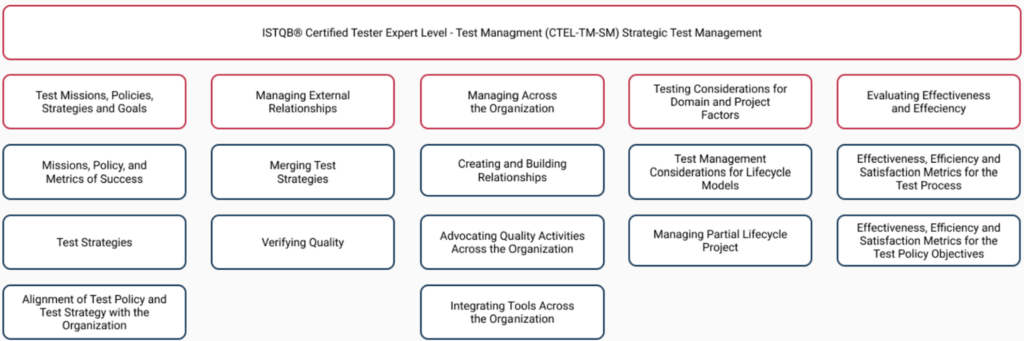
    Expert Operational Test Management

    The ‘Operational Test Management’ content within the overall, 3-part Test Management syllabus considers the skills needed for the Test Manager to manage third party relationships including contractual, communication, integration, and verification of quality aspects.

    It covers the ability to create, build, and maintain relationships with other managers and other teams, as well as project management skills, including project risk management, and organizing and moderating effective retrospective meetings. Reporting and interpreting test results by evaluation of exit criteria is elaborated upon, and metrics are described which play a crucial role in the management of the test process. Release considerations for the Test Manager are also highlighted.

    It addresses key subjects that include:

    • Managing External Relationships;
    • Project Management Essentials;
    • Test Project Evaluation and Reporting;
    • Test Considerations for Domain and Project Factors;
    • Evaluating Effectiveness and Efficiency.

    The syllabus is shown on page 32 and can be further downloaded here. The pass mark is 65% for the exam, which has two parts:

    • Multiple choice over 45 minutes;
    • Written response over 90-minutes;

    People awarded an overall Expert Test Management certificate should expect the following business-based outcomes:

    • Lead the test management within an organization, project or program to identify and manage critical success factors with management commitment at CEO/Board level;
    • Take appropriate business-driven decisions on a test management strategy and implement organization wide commitment and compliance based on quality KPIs;
    • Assess the current status of the test management, propose stepwise improvements and show how these are linked to achieving business goals within the organizational context of test management (organization or project/program);
    • Set up a strategic policy for improving the test management and the testing, and implement that policy in an organization;
    • Analyze specific problems with the test management and its alignment with other roles or management areas in the project/organization, and propose effective solutions;
    • Create a master test plan with matching governance dashboard to meet or exceed the business objectives of the organization or a project/program;
    • Develop innovative concepts for test management (project) organizations which include required roles, skills, methodologies (tools) and organizational structure;
    • Establish a standard process for implementing test management in an organization (project/program) with standardized delivery based on quality KPIs;
    • Lead an organization to improve the test management process and manage the introduction of changes;
    • Understand and effectively manage the human issues associated with test-project management and implement necessary changes.
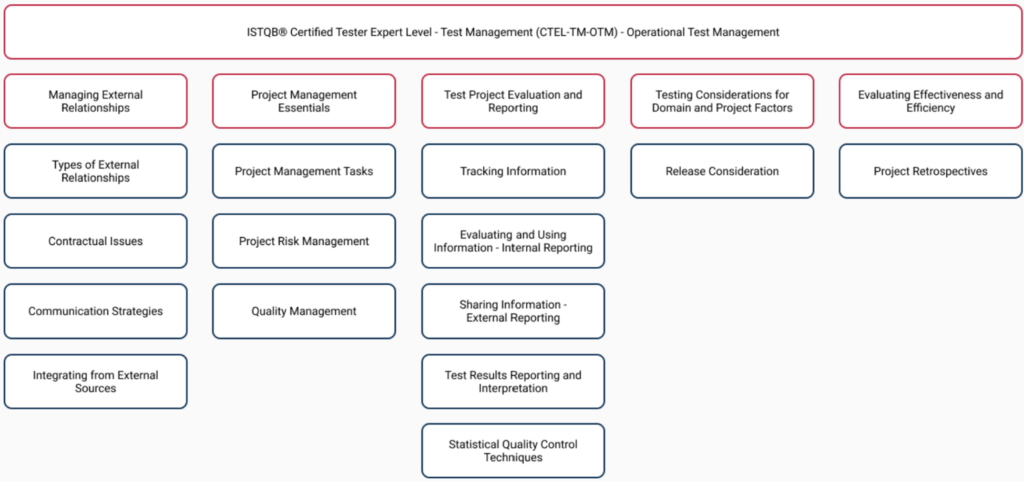
    Expert Managing the Test Team

    The ‘Managing’ content within the overall, 3-part Test Management syllabus considers the people management skills that are a critical part of the Test Manager’s role and necessary to build, develop and lead test teams in organizations. This includes recruitment, setting goals and objectives, individual personalities and roles within teams, performance reviews, motivating and challenging the team and managing distributed teams. Being able to manage across the organization is another core part of the Test Manager’s role including being able to advocate, defend and promote the test team and its contribution to the organization, being able to communicate with stakeholders, advocating quality across the organization and being able to manage ethical issues.

    There are only two primary subjects, this part of the Test Management certification considers strategic subjects including:

    • Managing the Test Team;
      • Building the Test Team;
      • Developing the Test Team;
      • Leading the Test Team.
    • Managing Across the Organization.
      • Advocating the Test Team;
      • Placement of the Test Team;
      • Stakeholder Communication;
      • Managing Ethical Issues.

    The syllabus is shown on page 35 and can be further downloaded here. The pass mark is 65% for the exam, which has two parts:

    • Multiple choice over 45 minutes;
    • Written response over 90-minutes;

    People awarded an overall Expert Test Management certificate should expect the following business-based outcomes:

    • Lead the test management within an organization, project or program to identify and manage critical success factors with management commitment at CEO/Board level;
    • Take appropriate business-driven decisions on a test management strategy and implement organization wide commitment and compliance based on quality KPIs;
    • Assess the current status of the test management, propose stepwise improvements and show how these are linked to achieving business goals within the organizational context of test management (organization or project/program);
    • Set up a strategic policy for improving the test management and the testing, and implement that policy in an organization;
    • Analyze specific problems with the test management and its alignment with other roles or management areas in the project/organization, and propose effective solutions;
    • Create a master test plan with matching governance dashboard to meet or exceed the business objectives of the organization or a project/program;
    • Develop innovative concepts for test management (project) organizations which include required roles, skills, methodologies (tools) and organizational structure;
    • Establish a standard process for implementing test management in an organization (project/program) with standardized delivery based on quality KPIs;
    • Lead an organization to improve the test management process and manage the introduction of changes;
    • Understand and effectively manage the human issues associated with test-project management and implement necessary changes.
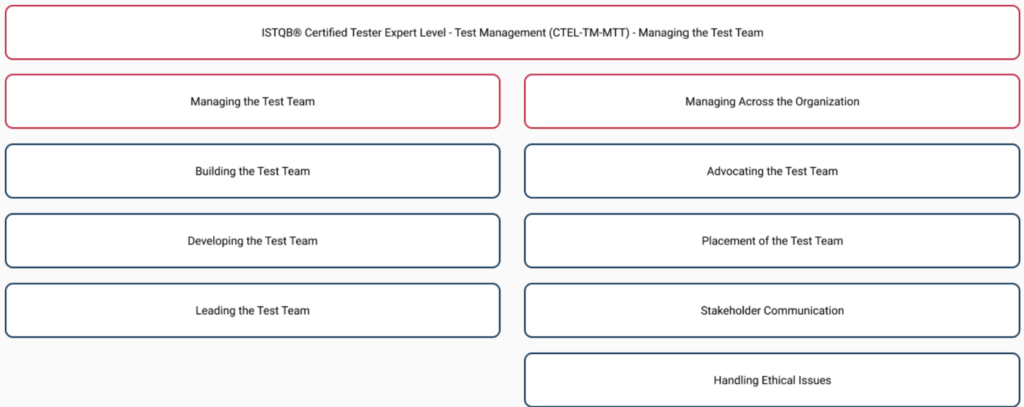

  • An In-Depth Look at the ISTQB® Certified Tester Foundation Level (CTFL) Version 4.0

    An In-Depth Look at the ISTQB® Certified Tester Foundation Level (CTFL) Version 4.0

    The International Software Testing Qualifications Board (ISTQB®) has recently announced the release of the Certified Tester Foundation Level (CTFL) Version 4.0 course. Approved by a successful vote, this new version is designed to align with current software development and testing approaches, marking a significant evolution in the certification that is highly recognized in the software testing industry.

    Updated CTFL 4.0 Release Package

    The ISTQB Foundation in Software Testing ( CTFL )4.0 release package offers a comprehensive set of resources that include an updated syllabus, a sample exam, and revised exam structure and rules. The new syllabus offers a clear and structured learning path, while the sample exam provides a practical tool for candidates to prepare effectively. The revised exam rules ensure clarity and fairness in the evaluation process. These resources are designed to equip aspiring and professional testers with the necessary knowledge and skills to thrive in the ever-changing field of software testing.

    Enhanced Syllabus and Learning Objectives

    The updated syllabus of the CTFL 4.0 course covers 14 Business Outcomes and 64 Learning Objectives, providing a robust framework of knowledge for software testing professionals. The course content has been carefully curated to align with industry demands, with a focus on practical skills and real-world scenarios. These updates ensure that CTFL certified professionals can confidently meet the challenges of modern software testing and contribute effectively to their organisations.

    Accreditation Guidelines for Training Providers

    ISTQB® has emphasized the importance of training providers applying for accreditation to deliver CTFL 4.0 courses. This ensures the uniformity and quality of training materials across different providers, leading to a consistent learning experience for candidates. Additionally, the mandated instructional hours guarantee a comprehensive coverage of the course content, thus maintaining the high standards of the CTFL certification.

    Upgrading to CTFL Version 4.0

    For holders of previous CTFL certifications, there is no requirement to retake the exam. However, upgrading to version 4.0 is highly recommended to stay up to date with the latest skills and knowledge in the field of software testing. With the rapidly evolving technology landscape, staying current is crucial to maintaining a competitive edge in the industry.

    Sunset Dates for CTFL 3.1 Certification

    As we transition to CTFL 4.0, it’s important to note the sunset dates for the CTFL 3.1 certification. The English syllabus, exams, and accredited training will be phased out according to the timeline provided by ISTQB®. The sunset dates for other languages will follow suit. This information helps candidates and training providers plan accordingly, ensuring a smooth transition to the updated course.
    In conclusion, the CTFL 4.0 course is a significant milestone in the evolution of the ISTQB® certifications. With an updated syllabus, revised exam structure, and enhanced learning objectives, it offers a comprehensive and current learning experience for software testing professionals. Whether you’re new to the field or an experienced tester, upgrading to CTFL 4.0 will equip you with the latest skills, knowledge, and best practices to thrive in your career. As the software testing industry continues to evolve, staying ahead means staying updated. Take the first step today!


  • The Importance of ISTQB Certification in the Software Testing Industry

    The Importance of ISTQB Certification in the Software Testing Industry

    In today’s fast-paced digital world, software testing plays a vital role in ensuring the quality and reliability of software applications. As the demand for skilled software testers continues to grow, professionals in this field are constantly seeking ways to enhance their skills and improve their career prospects. One effective way to achieve this is by obtaining the ISTQB (International Software Testing Qualifications Board) certification. In this comprehensive guide, we will explore the importance of ISTQB certification in the software testing industry and how it can significantly impact career growth and opportunities.

    Understanding ISTQB Certification

    The ISTQB certification is a globally recognised qualification that validates a professional’s knowledge and skills in software testing. It is designed to provide a standardized framework for testing professionals, enabling them to demonstrate their expertise in various aspects of software testing. The certification is available at different levels, including the Foundation Level, Advanced Level, Specialist and Expert Level, each catering to different levels of experience and expertise.

    Benefits of ISTQB Certification

    1. Enhanced Knowledge and Skills

    Obtaining an ISTQB certification equips professionals with in-depth knowledge and understanding of fundamental concepts, principles, and best practices in software testing. The certification covers a wide range of topics, including test design techniques, test management, test tools, and test automation. By gaining this knowledge, professionals can make informed decisions, adopt industry-standard practices, and effectively contribute to the success of software testing projects.

    1. Industry Recognition

    ISTQB certification is globally recognized and respected by employers, clients, and industry professionals. It serves as a testament to an individual’s expertise and commitment to their profession. Having ISTQB certification on your resume can significantly enhance your credibility and make you stand out among other candidates in the competitive job market. Employers often prioritize candidates with ISTQB certification as it provides assurance of their skills and capabilities.

    1. Career Advancement

    ISTQB certification opens up a world of opportunities for career advancement. With the certification, professionals can explore various roles in the software testing field, such as Test Analyst, Test Manager, Test Automation Engineer, and Quality Assurance Manager. These roles often come with increased responsibilities, higher compensation, and better growth prospects. Additionally, the certification serves as a solid foundation for professionals who aspire to pursue specialized certifications or roles in software testing, such as security testing or performance testing.

    1. Improved Job Opportunities

    The demand for skilled software testers is constantly increasing, and many organizations now consider ISTQB certification as a prerequisite for hiring software testing professionals. Having the certification gives you a competitive edge in the job market and increases your chances of landing your dream job. It demonstrates to employers that you possess the necessary skills and knowledge to perform effectively in a software testing role. With ISTQB certification, you can explore job opportunities in various industries, including IT, finance, healthcare, and e-commerce.

    1. Networking and Professional Development

    ISTQB certification provides professionals with opportunities to connect and network with other certified software testers around the world. This global community allows for knowledge sharing, collaboration, and professional development. By participating in events, forums, and online communities, certified professionals can stay updated with the latest trends, advancements, and challenges in the software testing industry. Networking with experienced professionals can also open doors to mentorship and learning opportunities, further enhancing one’s career growth.

    Preparing for ISTQB Certification

    To obtain ISTQB certification, professionals need to undergo training and pass the certification exam. The training covers the syllabus and prepares candidates for the exam. TSG Training offers accredited ISTQB training courses to ensure the quality and relevance of the training material.

    The Future of ISTQB Certification

    As the software testing industry continues to evolve, ISTQB certification remains relevant and valuable. With the increasing adoption of agile development methodologies and the growing importance of automation in software testing, the ISTQB certification has adapted to incorporate these changes. The ISTQB Agile Tester certification, for example, focuses on agile testing principles and practices, enabling professionals to thrive in agile development environments.

    In conclusion, obtaining ISTQB certification is a significant step for professionals in the software testing industry. It not only enhances their knowledge and skills but also opens up new career opportunities and increases their marketability. By investing in ISTQB certification, professionals demonstrate their commitment to excellence and position themselves as valuable assets in the ever-evolving field of software testing. So, if you aspire to excel in software testing and propel your career to new heights, consider obtaining the ISTQB certification. It is a worthwhile investment that can bring long-term benefits and open doors to a world of possibilities.

  • What Is ITIL®?

    What Is ITIL®?

    For business owners, it is important to hire skilled professionals to protect their IT investments. As a result, many organisations will be looking for someone who has ITIL® certification, and it can offer an exciting and lucrative career path. If you’re a business owner, you might even be considering training members of your team so you have an in-house professional at hand. Whichever of these apply, you can find out all you need to know right here.

    What does itil stand for?

    Since the latter half of the 80s, ITIL® has been the framework standard regarding IT delivery and service management. However, what does itil stand for? It stands for Information Technology Infrastructure Library.
    This is a set of the best IT practices put together to help businesses align IT services with the needs of customers and businesses. Some of these practices include accessibility, IT-related assets and resources offering benefits and value to customers.
    During the very early days, information technology departments were seen to be the cost centre of the business. However, when IT was first implemented, collaboration and communication between the business and those in the IT department were poor. Thanks to firms lacking formalised processes, the perception was that IT didn’t add value and wasn’t effective in serving the goals and needs of the business.
    However, things have drastically changed with maturity as businesses recognised the need to show off value when they catered to the specific needs of the organisation. This saw the emergence of IT Service Management.
    Today the ITIL® framework has become the most widely accepted and has become the standard in the management of the lifecycle of IT services along with the delivery.

    The origins of ITIL®

    The CCTA, Central Computing and Telecommunications Agency in Great Britain, were the first to develop the ITIL® framework in 1986 when the government realised its IT was becoming increasingly costly. They recognised the need to create a methodology for IT service management to enable cost savings and ensure resources were used more efficiently.
    Compared with later versions of itil, the first ever version was unrefined and was released in 40 different volumes giving guidance on such as:

    • Service level management;
    • Change management;
    • Help desk management;
    • Problem management;
    • Cost management;
    • Contingency planning;
    • Configuration management;
    • And more.


    The first and most significant itil evolution and the way forward

    The first biggest evolution of ITIL® came in 2001 when v2 was released, and in 2005 the ITIL® V2 glossary was released to clarify terms within the framework that had previously been poorly defined.
    In 2007 ITIL® V3 was released by way of five publications. These were:

    • Service strategy;
    • Service design;
    • Service operation;
    • Service transition;
    • Continual service improvement.

    This set went on to become known as ITIL® 2007 and described the processes and functions that were comprehensive and supported various aspects of IT service delivery. In addition, it covered all of the required steps of IT service management.
    In 2014 AXELOS took over the ownership of the ITIL® framework; this was a joint venture of Capita PLC professional services firm, and the UK government. The framework continued to be updated and refined, along with them overseeing the accreditation of ITIL® certification and training institutions worldwide.
    In 2019 ITIL® 4 was released and saw changes to how IT organisations did ITSM. It is also the most significant update to the framework since 2007. This was thanks to the new four dimensions model identifying four factors critical to a successful value delivery with ITIL®. These were organisations, people, information and technology, partners and suppliers, and value streams and processes.
    With the release of ITIL® 4 came a new certification scheme, and the very first certification, ITIL® Foundation, was released in 2019/2020. AXELOS identified four certification levels for ITIL® 4, which were:

    • ITIL® Foundation;
    • ITIL® 4 Managing Professional;
    • ITIL® 4 Strategic Leader;
    • ITIL® Master.


    What are ITIL® courses and service management training?

    Taking an itil course is an option for anyone who works in the IT services industry or within a project management role. Courses provide individuals with further knowledge of IT, which helps them progress through their IT careers.
    Service management courses are greatly sought after by businesses as they show knowledge of IT services and show a solid understanding.

    ITIL® training options

    There are many choices of ITIL courses and IT service management training to choose from, with courses being available for all skill levels.

    The ITIL® V4 Foundation Course

    The ITIL® V4 Foundation course is the starting point for anyone who wants to gain accreditation. This course is an introduction and allows candidates to take a look at IT service management via an end-to-end operating model for the creation, delivery and continual improvement of tech-related products and services.
    The course takes the candidate through numerous aspects and key points for three days. After that, you can take the exam (included within the course with TSG Training) to test your understanding and to achieve your qualification. Find out more about the ITIL® V4 Foundation course with TSG Training.

    The ITIL® Specialist High-Velocity IT Course

    The ITIL® Specialist High-Velocity IT Course is at the middle of the spectrum of courses, and before taking this course, you must have passed the Foundation examination.
    The HVIT qualification, as the course is called, gives an understanding of ways in which digital organisation and digital operating models function in high-velocity environments. The course focuses on the rapid delivery of services and products to get maximum value. It gives the candidate an understanding of working practices, including Lean, Agile and technical practices, along with technologies, including The Cloud, Automation and Automatic Testing.

    ITIL® 4 Strategist Direct, Plan & Improve Course

    The ITIL® 4 Strategist Direct, Plan & Improve Course is offered by TSG Training, and to be able to sit the exam, the candidate needs to have passed the Foundation exam.
    The course gives practical skills that are needed to create learning and improving IT organisation which has a strong, effective strategic direction. The course teaches a practical and strategic way to plan and deliver continuously with the necessary agility. It is split into 12 modules, and it is an intensive course taken over three days.
    ITIL® can be a fantastic certification for both your individual career and to benefit the wider organisation. However, with many courses available, it can be hard to know which is the right option for you. If you’re unsure, please contact the TSG Training team for a free consultation. Our friendly advisors will talk you through the different options and find the right choice for you depending on your expertise, career and business needs.